
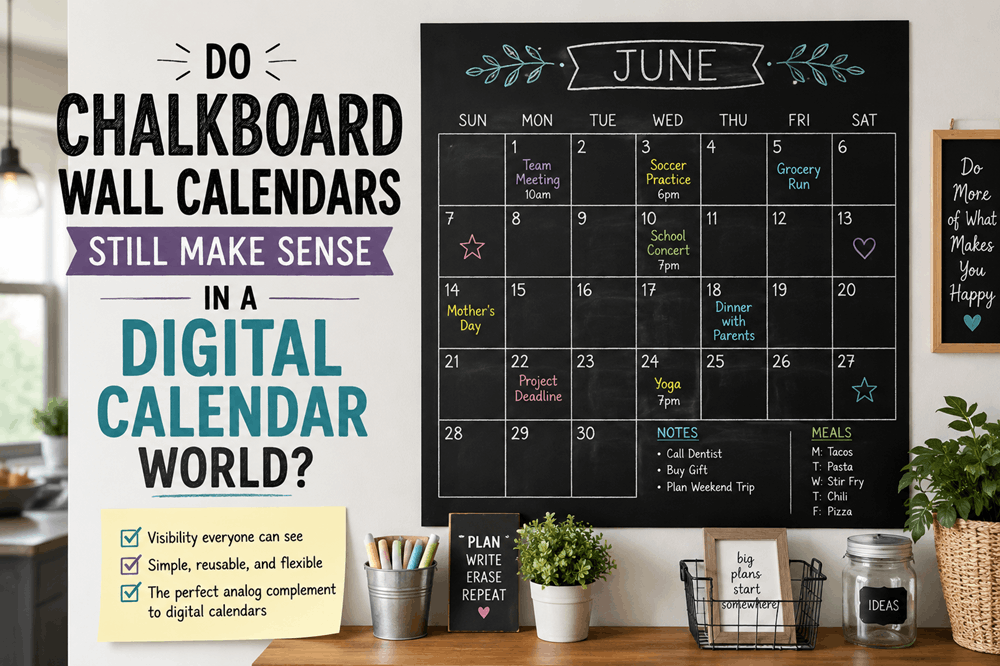
Chalkboard wall calendars feel like something from a simpler internet era. You write the month by hand, add birthdays, appointments, bills, school events, dinner plans, and one dramatic “DO NOT FORGET” note. Then the month ends, you erase it, and you start again.
In a world full of Google Calendar alerts, shared iPhone calendars, Slack reminders, smart displays, and digital wall planners, that may sound old-fashioned. But a chalkboard wall calendar still has one useful trick: it puts the plan where people can actually see it.
Quick Take
A chalkboard wall calendar is still useful if you want a simple planning system for a kitchen, office, entryway, classroom, studio, or family command center. It works best for big-picture planning: appointments, chores, meals, trips, school schedules, content calendars, project deadlines, and household reminders.
It is not the best choice if you need automatic syncing, recurring reminders, color-coded shared calendars, or notifications. For that, a digital calendar still wins. The best setup for many people is using both: digital for alerts and details, chalkboard for the shared overview.
Best For / Skip If
| Best for | Skip if |
|---|---|
| Families, roommates, kitchens, classrooms, home offices, meal planning, chore charts, visual schedules, and people who like writing things down. | Your schedule changes constantly, you need alerts, you hate chalk dust, or your household already ignores wall notes. |
Why the Idea Still Works
The appeal is simple. A chalkboard wall calendar turns your schedule into part of the room.
Calendars hidden inside phones are easy to miss. A digital alert can be dismissed in one tap. A shared calendar can be forgotten if someone does not check it. A wall calendar works because it does not ask anyone to open an app.
For families, roommates, small teams, or anyone juggling several moving pieces, that can be surprisingly helpful. A wall calendar gives everyone one common surface. People can see what is happening this week, add a note, and notice when a day is already overloaded.
What the Original Chalkboard Calendar Trend Got Right
The old NerdLike post was excited about a wall decal calendar from Simple Shapes, an early-2010s design idea built around a reusable home calendar. That was the right instinct. The calendar was not just about decoration. It was about making planning feel less disposable.
Instead of buying a new paper calendar every year, a chalkboard wall calendar could reset every month. That made it feel practical, stylish, and a little clever. It also fit perfectly into that era of home-decor internet: wall decals, chalkboard labels, handmade shops, kitchen command centers, and DIY organization boards.
Today, the trend looks different, but the problem is the same. People still forget appointments. Families still ask what time practice starts. Freelancers still need to see deadlines. Meal plans still fall apart by Wednesday. A reusable wall calendar remains a low-tech fix for everyday planning chaos.
Chalkboard Calendar vs. Phone Calendar
A phone calendar is better for precision. It can send alerts, sync across devices, repeat events, invite other people, attach locations, and update automatically when plans change.
A chalkboard calendar is better for shared awareness. It turns the month into something people can understand at a glance. You do not have to unlock a phone, open an app, switch views, or remember which account holds the event.
That difference matters. Digital calendars are excellent personal systems. Wall calendars are better shared systems. If the goal is to remind one person about a dentist appointment, use the app. If the goal is to help a whole household understand the week, put it on the wall.
The best setup is usually not either-or. Use your digital calendar as the source of truth for times, locations, and reminders. Use the chalkboard calendar as the visible dashboard.
Where a Chalkboard Wall Calendar Works Best
The best place is somewhere people naturally pass every day. A kitchen wall is the classic choice because it is already a planning zone. Groceries, meals, school notes, mail, keys, and daily routines tend to collect there.
An entryway can also work well because it gives people one last reminder before they leave the house. A home office is a good fit for deadlines, editorial planning, invoices, meetings, and project milestones.
Classrooms, studios, dorm rooms, and small business spaces can use the same idea. A chalkboard calendar is especially useful when the schedule is shared but not complicated enough to justify a full digital display.
Paint, Decal, or Framed Board?
There are three common ways to get the chalkboard calendar look.
A chalkboard wall decal is the easiest option. You stick it on the wall, use it, and remove it later. This is good for renters or anyone who does not want to paint. The downside is that cheaper decals can peel, bubble, or stain over time.
Chalkboard paint gives you the most custom look. You can paint a full wall, a framed rectangle, a cabinet door, or a section of a home office. It feels more permanent and can look great when done carefully. The downside is prep. The surface needs to be smooth, and the paint needs proper curing before regular use.
A framed chalkboard calendar is the safest middle option. You can hang it like art, move it later, and avoid painting the wall. It may not look as seamless as a full wall calendar, but it is easier to replace if your system changes.
Chalk vs. Chalk Markers
Regular chalk gives you the classic look. It is soft, erasable, cheap, and forgiving. It also creates dust and can look messy if you write small.
Chalk markers look cleaner and brighter. They are better for neat lines, color coding, and readable calendar boxes. They can also stain or ghost depending on the surface. Some chalk markers are meant for non-porous boards only, so check the marker label before using them on painted walls or vinyl decals.
Before using chalk markers heavily, test a small corner first. For a calendar, the best setup is often simple: regular chalk for flexible daily notes and chalk markers only if your surface can handle them.
The Maintenance Problem Nobody Mentions
A chalkboard wall calendar looks great when it is fresh. The real test is month three.
Chalk dust builds up. Marker residue can ghost. Edges can smudge. Handwriting can get cramped. If the board is in a kitchen, grease and humidity may make cleaning harder. If kids use it, the calendar may slowly become half schedule and half dinosaur gallery.
That does not mean it is a bad idea. It just means the calendar needs a little maintenance. Wipe it fully at the end of each month. Use a soft cloth. Avoid harsh scrubbing unless the paint or surface maker says it is safe. If you used chalkboard paint, follow the product instructions for curing and conditioning before writing on it heavily.
The cleaner the system, the more likely people are to keep using it.
How to Make One Actually Useful
The biggest mistake is making the calendar too cute to use. If every box is tiny, every label is decorative, and every line needs perfect handwriting, people will avoid touching it.
Make the layout practical first. Use large day boxes. Leave space for short notes. Keep a section for reminders that do not belong to a specific day. Add a small area for meal ideas, bills, school notes, or weekly priorities if those fit your life.
Color coding can help, but do not overdo it. One color for appointments, one for school or kids, one for bills, and one for meals is usually enough. If people need a legend to understand the board, it is too complicated.
The goal is not to create a Pinterest-perfect wall. The goal is to make the next seven days easier to understand.
Quick Setup Tips
- Put it somewhere people walk past every day.
- Use large boxes, not tiny decorative squares.
- Keep one area for notes that do not fit a date.
- Limit color coding to three or four categories.
- Use your phone calendar for alerts and exact times.
- Clean and reset it fully at the end of each month.
What About Digital Wall Calendars?
Digital wall calendars are the modern version of the same idea. Instead of rewriting the month by hand, they pull in events from tools like Google Calendar, Apple Calendar, Outlook, or work calendars and show them on a dedicated kitchen-style display.
Some also include chore lists, meal planning, weather, photo displays, family profiles, tasks, and other planning tools. They are useful, especially for families already living inside shared digital calendars.
The downside is cost, power, software support, subscriptions, privacy, and the simple fact that another screen is still another screen.
A chalkboard calendar is cheaper, quieter, and more personal. A digital wall calendar is smarter, faster, and easier to keep updated. The right choice depends on what problem you actually have.
If your issue is missed alerts and constantly changing events, go digital. If your issue is that nobody sees the plan, a chalkboard calendar may be enough.
Who Should Try a Chalkboard Wall Calendar?
A chalkboard wall calendar makes sense for people who like visual planning. It is especially useful for families, roommates, teachers, small teams, freelancers, meal planners, and anyone who feels scattered by app-only scheduling.
It also works well for people who enjoy analog tools. Some brains simply respond better to writing things down. The act of physically writing an appointment can make it feel more real than typing it into a box on a screen.
But it is not for everyone. If your schedule changes constantly, rewriting the board may become annoying. If you hate chalk dust, use a dry-erase board or digital display instead. If your home already has too much visual clutter, a giant wall calendar may add stress rather than remove it.
Final Take
Chalkboard wall calendars still make sense because important plans are easier to remember when they are placed in the path of daily life.
They are not smarter than your phone. They do not sync, buzz, update automatically, or send alerts. But that is also part of their charm. They are calm, reusable, and hard to miss.
The best version is not a perfect decor piece. It is a working surface. Put it somewhere useful, keep the layout simple, clean it regularly, and let it be a little messy. A calendar that people actually use is better than one that only looks good online.