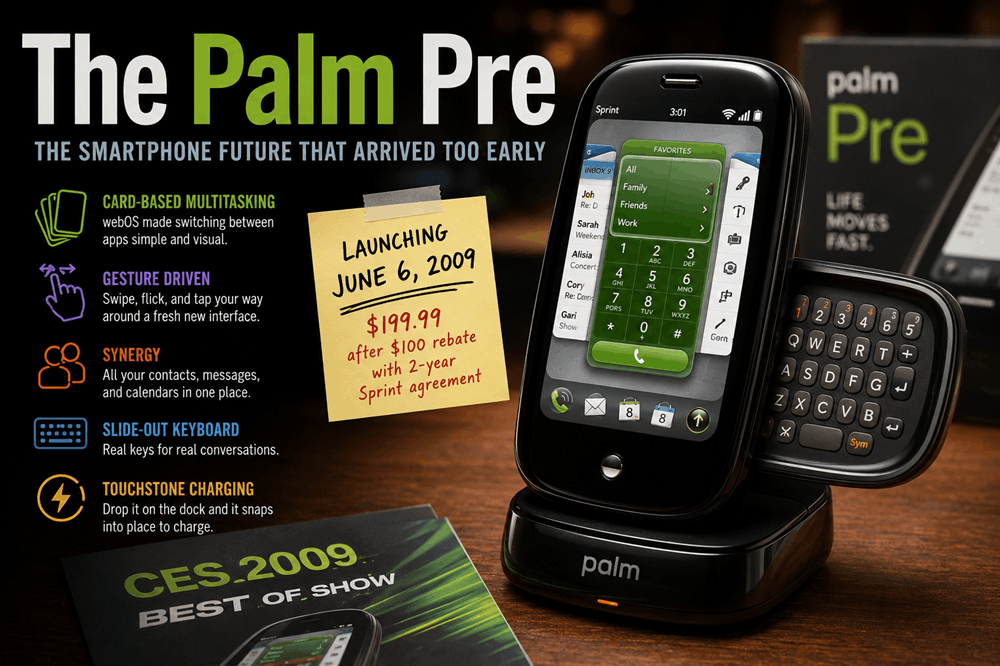
The Palm Pre was one of the most exciting phones of 2009. Before it launched, tech blogs were tracking rumors, release dates, carrier details, and every tiny sign that Palm might finally have a real iPhone challenger.
Looking back, the Pre feels like one of tech’s great “almost” devices. It had smart software, real multitasking, a physical keyboard, gesture controls, and a wireless charging dock before those ideas felt normal. But a clever phone still needs strong hardware, carrier reach, developer support, and timing. That is where Palm struggled.
Quick Take
The Palm Pre matters because it showed a different path for smartphones. Its webOS software used card-based multitasking, gesture controls, contact syncing, and a clean app-switching system that still feels surprisingly modern in memory.
But the Pre also proves that good ideas do not automatically win. Palm had a bold vision. Apple and Google had the momentum.
Palm Pre at a Glance
| U.S. launch date | June 6, 2009 |
|---|---|
| Launch carrier | Sprint exclusive in the U.S. |
| Launch price | $199.99 after a $100 mail-in rebate with a two-year agreement |
| Operating system | webOS |
| Standout ideas | Card multitasking, gesture controls, Synergy, slide-out keyboard, and Touchstone charging |
| Why it matters now | It previewed several smartphone ideas that later became common, even though Palm could not turn them into a lasting mobile platform. |
What the Old NerdLike Post Was Probably About
The old NerdLike page likely covered a release-window rumor. The URL slug, “palm-pre-to-be-released-in,” strongly suggests a headline like “Palm Pre to Be Released in June.”
That would make sense for April 2009. At that point, the Palm Pre had already been announced, but its exact U.S. launch date had not yet been officially confirmed. Tech sites were watching Sprint rumors, leaked training schedules, and launch-window chatter because the Pre was one of the few phones that made the post-iPhone smartphone race feel unpredictable.
The official answer came later. Sprint and Palm announced that the Palm Pre would launch nationwide on June 6, 2009, for $199.99 after a $100 mail-in rebate with a new two-year Sprint service agreement.
The Hype Started Before Launch
The Palm Pre did not come out of nowhere. Its comeback story really started at CES 2009, where it won major attention and helped change the mood around Palm.
That mattered because Palm was not a random company trying to make a phone. It had history. Long before the iPhone, Palm devices helped define the PDA era. The PalmPilot, Treo, and other Palm products trained users to think of a pocket device as a calendar, address book, note tool, email machine, and productivity companion.
By 2009, though, Palm needed a reset. The iPhone had changed expectations. BlackBerry still had business users. Android was growing. Windows Mobile felt old. Nokia was still powerful globally but less exciting in the U.S. market.
The Palm Pre entered that messy moment with a new operating system, a compact design, and enough originality to make people wonder if Palm had found its way back.
webOS Was the Real Star
The Palm Pre’s best idea was not the shape of the phone. It was webOS.
webOS treated apps like cards. You could open several apps, swipe between them, and flick one away to close it. That sounds ordinary now, but in 2009 it felt elegant and obvious in the best way. Smartphone multitasking was still awkward, limited, or hidden on many devices. The Pre made it visual.
The gesture area below the screen also gave the phone a distinct feel. Instead of relying only on buttons, webOS used swipes and gestures to move through the system. It made the interface feel fluid, almost like the phone had a small control surface built into its face.
Another clever feature was Synergy, Palm’s name for pulling contacts, calendars, and messages from different services into one cleaner view. That was a smart answer to a real problem. People were beginning to live across Gmail, Facebook, work email, instant messaging, and multiple address books. webOS tried to make that mess feel manageable.
The Hardware Was Charming but Flawed
The Palm Pre had a compact, pebble-like design with a touchscreen on the front and a slide-out QWERTY keyboard underneath. That keyboard mattered. Many people still wanted real keys, especially after years of BlackBerry and Treo muscle memory.
The phone felt friendly and pocketable. It was not a giant slab. It had personality. It looked like something from a more playful branch of smartphone history.
But the hardware did not always match the software. Some users complained about build quality, the slider mechanism, battery life, and the small keyboard. The Pre had charm, but it did not feel as solid or inevitable as the iPhone was starting to feel.
That mismatch hurt. webOS made the phone feel fresh. The hardware sometimes made it feel fragile.
The Touchstone Charger Was a Nerdy Little Preview
One of the coolest Palm Pre accessories was the Touchstone charger. It used a magnetic charging dock and a special back cover so the phone could charge without plugging in a cable each time.
In 2009, that felt futuristic. Wireless charging was not yet a normal phone feature. Palm made it feel clean and satisfying: place the phone on the dock, let it snap into place, and charge.
Today, wireless charging is common. Phones, earbuds, and watches use charging pads all the time. The Touchstone is a reminder that Palm was not short on imagination. Some ideas simply needed a bigger ecosystem around them.
Sprint Exclusivity Made the Comeback Harder
The Palm Pre launched in the U.S. on Sprint. That gave Sprint an exciting exclusive, but it also limited Palm’s reach.
Carrier exclusivity was normal then. The iPhone was tied to AT&T in the U.S., and carriers still had huge control over phone distribution. But Palm needed scale badly. It needed buyers, developers, reviewers, and curious switchers to gather quickly.
Sprint had loyal customers, but it did not give Palm the same cultural spotlight Apple had with the iPhone. A great phone on a smaller carrier had to work harder to become the obvious choice.
That is one of the cruel parts of the Palm Pre story. It had enough buzz to get attention, but not enough reach to turn that attention into a durable platform.
The App Problem Was Real
By 2009, apps were becoming central to smartphones. Apple’s App Store had already changed what people expected from a phone. Android Market was young but growing. Developers were starting to choose platforms based not only on technology, but also on audience size and business potential.
webOS had a beautiful interface, but Palm had to convince developers to build for it. That was not easy. Developers follow users. Users follow apps. Once that loop starts favoring bigger platforms, smaller ones struggle.
The Pre did have apps, and webOS had devoted fans. But it never built the kind of app momentum that iOS and Android did. For ordinary buyers, that mattered. A phone could have better multitasking and still lose if the apps people wanted were somewhere else.
What the Palm Pre Got Right
The Palm Pre deserves credit for several ideas that aged well.
It made multitasking visual. It treated app switching as something normal people should understand, not a hidden power-user feature.
It respected messaging-heavy users by keeping a physical keyboard. At a time when many people still did not fully trust touchscreen typing, that mattered.
It made wireless charging feel elegant before wireless charging became ordinary.
It tried to unify scattered online identities through Synergy. That was a practical idea in a world where people were spreading their digital lives across more services every year.
Most of all, it proved that the iPhone was not the only source of fresh smartphone thinking. Palm still had design imagination left.
What the Palm Pre Got Wrong
The Pre’s biggest problem was not one single mistake. It was the pileup.
The hardware needed to be stronger. The battery needed to last longer. The app catalog needed to grow faster. Palm needed more carrier reach, more developer energy, and more money than it had.
The phone also launched into a market that was moving brutally fast. Apple was improving the iPhone each year. Android was spreading across many manufacturers. BlackBerry still had loyal business users. The Pre was not competing with one phone. It was competing with entire ecosystems.
The Pre also faced early privacy questions after reports that webOS sent location and app-use data back to Palm. That issue feels very modern now. Even in 2009, smart connected phones were already raising questions about what data they collected and how clearly users understood it.
What Happened to webOS?
HP bought Palm in 2010, then tried to push webOS through phones and the HP TouchPad. That effort did not last. HP exited webOS hardware in 2011, ending Palm’s mobile comeback in practical terms.
The strange twist is that webOS did not fully disappear. LG acquired webOS technology from HP in 2013 for use in smart TVs. So the operating system that once tried to save Palm phones eventually found a second life on living-room screens.
That is a very tech-history ending. The smartphone platform lost the phone war, but some of its software DNA kept moving.
Why the Palm Pre Still Has Fans
The Palm Pre still has a soft spot in tech nostalgia because it felt original. It was not just an iPhone clone. It had its own interface ideas, its own shape, and its own personality.
People remember the cards. They remember the Touchstone charger. They remember the satisfying slide of the keyboard. They remember believing Palm might actually pull off a comeback.
That matters. Not every commercially struggling gadget is forgettable. Some products lose the market but still influence what people expect from technology. The Pre belongs in that category.
What Modern Phones Can Learn From It
The Palm Pre is a reminder that smartphones can still use more personality. Modern phones are powerful, polished, and often excellent. They also look and feel very similar.
The Pre came from a time when companies were still experimenting with shapes, keyboards, gestures, charging docks, and operating-system ideas. Not every experiment worked, but the industry felt more willing to try strange things.
Modern foldables, compact phones, e-ink devices, gaming phones, minimalist phones, and AI-first gadgets are all chasing some version of that same feeling: maybe a phone does not have to be just another glass slab.
Final Take
The Palm Pre was not a total failure, and it was not a hidden masterpiece that everyone simply misunderstood. It was something more interesting: a bold, flawed phone with ideas that deserved more time than the market gave it.
Its release hype made sense. In 2009, Palm still had a name, webOS looked fresh, and the Pre offered a real attempt to rethink smartphone multitasking. The problem was that a clever interface could not beat larger ecosystems on its own.
That is why the Palm Pre still feels worth revisiting. It reminds us that the future does not always win on the first try. Sometimes it shows up early, charms the nerds, loses the market, and leaves pieces of itself behind.