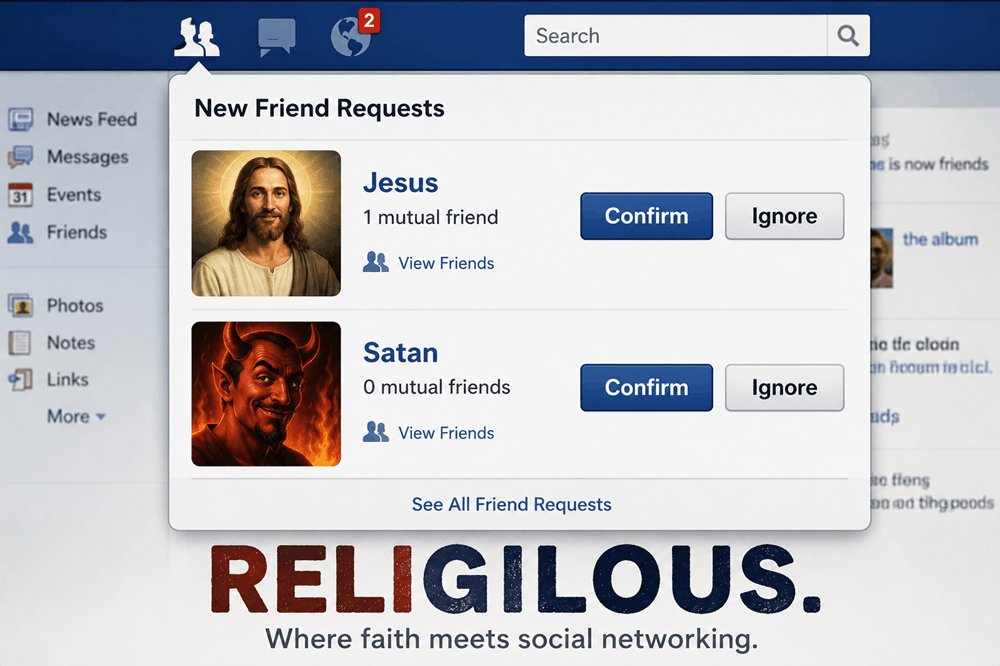
Before memes became a full internet language, some of the best online jokes were simple “what if” images. What if sacred figures had social profiles? What if ancient symbols showed up inside everyday web notifications? What if Jesus and Satan appeared as pending friend requests?
That was the joke behind the old NerdLike post titled “Religilous.” It was short, visual, and very 2008: a religious joke built around profile culture and friend-list awkwardness. Today, it reads less like a random gag and more like a small snapshot of how early internet humor worked.
Quick Take
Religious memes became early online comedy because they mixed two things people instantly understood: familiar religious figures and familiar web interfaces. The humor came from contrast. Ancient stories, sacred symbols, and cosmic opposites were suddenly treated like ordinary profile activity.
That kind of joke worked especially well in the late-2000s blog era. Facebook, MySpace, Twitter, and other platforms were changing how people thought about identity, friendship, belief, and public performance. A fake “friend request” from Jesus or Satan was funny because it made divine drama look like everyday internet awkwardness.
Old Post Context
| Old title | Religilous |
|---|---|
| Published | December 2, 2008 |
| Likely content | A fake social-network friend request image featuring Jesus and Satan |
| Source credit | Via ArtLung |
| Fresh angle | How early profile culture turned religion and identity into quick visual jokes |
What the Old NerdLike Post Was Probably Sharing
The original NerdLike post was not a long essay. It was a quick image/link post from December 2008. The archived page shows the title “Religilous,” an embedded image described as “new friend requests jesus satan,” and a source credit to ArtLung.
That likely means the post showed a fake notification where Jesus and Satan appeared as new friend requests. The joke was not complicated. It took one of the biggest good-versus-evil pairings in religious imagination and squeezed it into one ordinary web action: accept, ignore, or maybe awkwardly leave the request pending forever.
The title also seems like a playful nod to Religulous, the 2008 Bill Maher documentary that used satire to challenge religious belief. NerdLike’s post was not necessarily about the film, but the timing and wordplay fit the same cultural moment: religion, comedy, skepticism, and internet culture were all colliding in public.
Why the Friend Request Joke Worked
A friend request is a tiny social decision. Do you accept? Do you ignore it? Do you pretend you never saw it? In the late 2000s, that was a newly common kind of online awkwardness.
Putting Jesus and Satan into that format made the joke instantly readable. You did not need a long caption explaining the setup. The interface did the work. It turned an enormous symbolic conflict into a small notification box.
The template mattered as much as the characters. A friend-request box already came with rules: someone wants access, you must choose, and the choice feels socially loaded. Once the viewer understands that template, the joke can be swapped onto almost anyone.
That is classic early meme logic. Take something serious, drop it into a familiar web format, and let the contrast carry the punchline.
Why Religion Became Familiar Meme Material
Religion is full of recognizable images, stories, characters, symbols, and moral tension. That makes it powerful material for comedy, but also sensitive material. A joke about a phone, app, or celebrity usually does not touch people’s deepest beliefs. A joke about Jesus, Satan, heaven, hell, prayer, angels, scripture, or church can land very differently depending on who sees it.
That is why religious memes have always had two audiences. Some people see them as harmless jokes about familiar symbols. Others see them as disrespectful, shallow, or just boringly edgy.
The best religious internet humor usually understands that tension. It does not need to mock believers to be funny. Sometimes the joke is really about the internet itself: how strange it is to imagine sacred figures using the same clumsy tools we use to manage acquaintances, birthday reminders, group chats, and awkward follows.
When Everything Became a Profile
The old “friend request” format worked because the internet was teaching people to imagine everyone as a profile.
Your friends had profiles. Bands had profiles. Brands had profiles. Fictional characters had profiles. Pets had profiles. People made joke accounts for celebrities, politicians, historical figures, and imaginary beings. It was only a matter of time before divine figures became part of that same joke language.
That was one of the strange shifts of the late-2000s web. Identity became a page with a photo, status, friends, likes, comments, and notifications. Once that format became familiar, comedy writers and casual meme-makers could apply it to almost anything.
Jesus and Satan as friend requests worked because the format made everything feel social, clickable, and weirdly ordinary.
Why Early Blog Posts Were So Short
A lot of old NerdLike-style posts were tiny by modern content standards. They often had one image, one line of text, and a source link. That was normal.
Blogs in the late 2000s often acted like curated internet scrapbooks. A blogger found a funny image, a gadget, a strange design object, or a weird video and posted it quickly. The value was not always in deep analysis. It was in spotting something amusing before your readers had seen it.
The “Religilous” post fits that pattern perfectly. It was probably not trying to explain theology, comedy, or social media. It was saying, “Here is a funny image. You might like this.”
That kind of post feels light now, but it was part of how internet culture moved before algorithmic feeds took over. People discovered weird things through blogs, not just through platforms.
From Religious Jokes to Religious Meme Communities
Religious meme humor did not stay in the simple friend-request era. It kept evolving as meme formats became more standardized.
Later, Christian memes, atheist memes, church memes, youth group jokes, Bible memes, theology memes, and parody devotional posts all found their own corners of the internet. Some were made by believers joking from inside their own communities. Some were made by skeptics. Some were friendly. Some were hostile. Some were just chaotic.
That range matters. A “Jesus meme” is not one thing. It can be devotional, ironic, sarcastic, evangelistic, critical, absurd, or purely silly. The same image might make one person laugh and another person roll their eyes.
That is part of why religious memes are interesting. They show how belief and internet humor can overlap without always meaning the same thing to everyone.
The Difference Between Satire and Cheap Shock
Religious comedy works best when it has an actual idea behind it. The friend-request joke worked because it placed a huge moral contrast inside a tiny social decision. That is a clear comic idea.
Cheap shock is different. It grabs a sacred symbol and tries to get attention by being rude. That can work for a second, but it usually does not age well.
A better religious meme says something about belief, internet behavior, community habits, social awkwardness, or the way old symbols fit into new platforms. The joke should have a shape. If the whole point is “this will annoy someone,” it is not very interesting.
Why These Memes Can Still Feel Current
The specific look of a 2008 friend-request image is dated now. The old interface, the image dimensions, the blog-credit style, and the idea of a single static joke all feel very pre-TikTok.
But the basic joke still works because modern apps keep turning identity into interface moments. Today, the same idea might show up as a fake DM, a group chat screenshot, a dating-app match, a TikTok comment, a Discord notification, or a “God followed you” parody account.
The format changes. The contrast stays the same: ancient symbols inside modern apps.
What This Says About Internet Culture
Internet culture has a habit of flattening everything into content. A religious figure, a political figure, a celebrity, a cartoon character, and your friend from high school can all appear in the same feed.
That flattening can be funny. It can also be strange. Sacred stories become templates. Serious ideas become reaction images. Community traditions become jokes for outsiders. Sometimes that creates clever commentary. Sometimes it strips away meaning.
The old “Religilous” image sits right in that tension. It is silly, but it also shows how profile culture changed the way people imagined relationships, even impossible ones. If everyone can be a profile, then even Jesus and Satan can become pending friend requests.
How to Write About Religious Memes Without Being Lazy
A modern article on this topic should not just repost the old image and call it a day. It should ask why the joke worked and what it says about the internet at that moment.
It should also avoid treating religion as one big target. People use faith online in many ways: worship, community, education, satire, debate, outreach, identity, comfort, and comedy. A smart piece can talk about religious memes without acting like everyone experiences them the same way.
That is the more interesting NerdLike angle. The joke is not only “haha, religion.” The better story is how social platforms turned almost everything, even sacred imagery, into something that could be reframed through notifications, friend lists, comments, and profiles.
Final Take
The old “Religilous” post was tiny, but it captured a real internet moment. A fake friend request still felt like a fresh joke format. Jesus and Satan needed no setup. The interface did the punchline work.
That makes it a small ancestor of modern religious meme culture. Today’s versions are faster, stranger, and more platform-specific, but the move is familiar: put an old symbol inside a new interface and let the contrast speak.
Sometimes the result is thoughtful satire. Sometimes it is just a cheap gag. But when it works, it reminds us how weird the internet really is. It can make anything look like a profile, even the oldest stories people tell about good, evil, belief, and doubt.