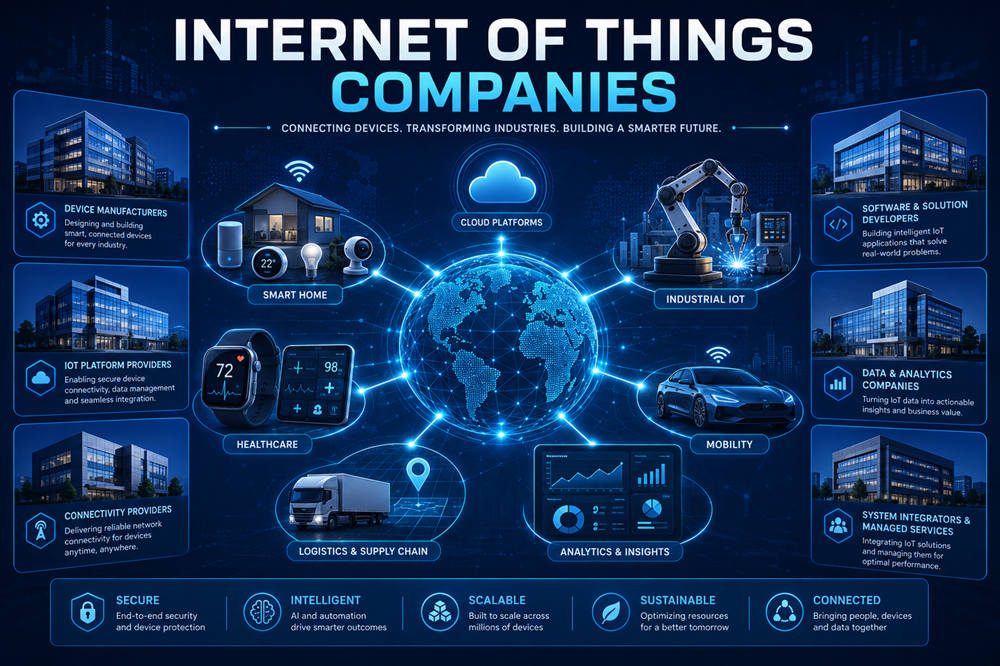
Internet of Things companies make everyday objects smarter. They build the devices, chips, sensors, networks, apps, and cloud systems that help physical products collect information and communicate online.
You see their work in smart homes, delivery trucks, factories, hospitals, farms, cars, power grids, and city systems. Some companies sell familiar consumer products, while others work behind the scenes powering large business and industrial networks.
What Are Internet of Things Companies?
Internet of Things companies create technology that connects physical devices to the internet. These devices can collect data, share updates, receive commands, and sometimes act automatically.
A smart thermostat is a simple example. It reads temperature, learns patterns, and adjusts settings through an app or voice assistant. A factory sensor is a larger example. It can track machine performance and warn a team when something needs attention.
Not every IoT company builds the same thing. Some focus on hardware, such as chips, sensors, cameras, or trackers. Others build software platforms, cloud tools, wireless networks, security systems, or dashboards that help people understand device data.
That is why the IoT industry includes many different types of businesses. A smart lock brand, a cloud provider, a chipmaker, and a fleet-tracking company can all belong in the same connected technology ecosystem.
Why Internet of Things Companies Matter
IoT companies matter because they help people see what is happening in the physical world without being there in person. Instead of guessing, you can use real-time information from connected products.
At home, IoT can help with comfort, safety, energy use, and convenience. You can check a doorbell camera, control lights from your phone, adjust a thermostat, or receive an alert if a leak sensor detects water.
For businesses, the value is often even bigger. Companies use IoT to track vehicles, monitor machines, manage inventory, reduce waste, improve safety, and respond faster when problems happen.
In healthcare, connected devices can support remote patient monitoring and equipment tracking. In agriculture, sensors can help farmers measure soil moisture, weather conditions, irrigation needs, and crop health.
The real power of IoT is not just the device. It is the useful information that device gives you at the right moment.
Major Types of Internet of Things Companies
The IoT market is easier to understand when you split it into categories. Each group plays a different role in making connected technology work.
1. IoT Cloud Platform Companies
IoT cloud platform companies help connected devices send, store, manage, and analyze data. They provide the digital backbone that many smart products rely on.
Major names in this space include AWS IoT, Microsoft Azure IoT, Google Cloud, IBM, and Oracle. These platforms are often used by businesses that need to manage large numbers of devices across different locations.
A smart appliance company might use a cloud platform to manage customer devices. A manufacturer might use one to collect data from machines across multiple factories. A transportation company might use it to track equipment and route information.
These platforms usually offer device management, security, analytics, app development tools, and artificial intelligence integrations.
2. Industrial IoT Companies
Industrial IoT companies focus on factories, utilities, energy systems, heavy equipment, and large-scale operations. This part of the industry is often called IIoT, or Industrial Internet of Things.
Companies like Siemens, Bosch, Honeywell, Schneider Electric, Rockwell Automation, GE Vernova, and PTC are major names in this category.
Their tools help companies connect machines, monitor production lines, manage energy use, and reduce unexpected downtime. In many cases, they help older industrial equipment work with modern software.
One of the most practical uses is predictive maintenance. Sensors can watch for changes in temperature, pressure, vibration, or performance. When something looks wrong, teams can fix the issue before a machine fails.
3. Networking and Connectivity Companies
Connected devices need reliable communication. Networking and connectivity companies make that possible.
Cisco, Verizon, AT&T, T-Mobile, Ericsson, Telit, and Semtech are examples of companies that support IoT networks, gateways, routers, cellular connections, and wireless communication tools.
Some IoT devices use Wi-Fi or Bluetooth. Others need cellular service, satellite links, or low-power networks designed for devices that send small amounts of data over long distances.
This category is especially important for fleets, agriculture, utilities, smart cities, and remote equipment. A sensor in a field, a tracker on a trailer, or a meter on a utility pole is only useful if it can send data when needed.
4. IoT Hardware and Chip Companies
Every connected device needs physical parts. These can include sensors, processors, batteries, antennas, cameras, wireless modules, and circuit boards.
Companies such as Qualcomm, Arm, Intel, NXP Semiconductors, Texas Instruments, STMicroelectronics, and MediaTek help power the hardware inside IoT products.
Their technology appears in smart speakers, wearables, connected cars, industrial sensors, medical devices, appliances, and security systems.
Hardware companies matter because IoT products often need to be small, efficient, affordable, and secure. A sensor may need to run for years on limited power, while a connected car system may need fast processing and strong wireless performance.
5. Fleet, Logistics, and Asset Tracking Companies
Fleet and asset tracking companies help businesses manage vehicles, equipment, shipments, trailers, tools, and field teams.
Well-known names include Samsara, Geotab, Verizon Connect, Trackunit, and Motive. These platforms often combine GPS tracking, dash cameras, driver safety tools, vehicle diagnostics, fuel monitoring, maintenance alerts, and reporting dashboards.
A delivery company can use IoT to see where its trucks are and whether routes are running on time. A construction company can track expensive equipment across job sites. A service business can monitor vehicles, driver behavior, and maintenance needs from one system.
This type of IoT is popular because it solves direct business problems. Lost equipment, unsafe driving, fuel waste, late deliveries, and surprise repairs can all cost money.
6. Smart Home and Consumer IoT Companies
Consumer IoT companies make connected products for homes and personal use. This includes smart speakers, cameras, thermostats, doorbells, locks, lights, appliances, TVs, and wearables.
Amazon, Google Nest, Apple, Samsung SmartThings, Ring, Philips Hue, Ecobee, Arlo, and Wyze are familiar names in this space.
These products are designed to make daily life easier. You can turn off lights from your phone, check a camera while you are away, lock a door remotely, or ask a voice assistant to adjust the temperature.
Consumer IoT is often the most visible part of the industry. It is also the area where privacy and security questions feel most personal, because many of these devices sit inside your home.
Well-Known Internet of Things Companies to Know
1. Amazon Web Services
Amazon Web Services is a major IoT cloud provider. Its IoT tools help businesses connect devices, manage messages, process data, and build large connected systems.
AWS IoT is used across smart products, industrial systems, automotive technology, and business operations.
2. Microsoft
Microsoft supports IoT through Azure and related cloud tools. Its platform is useful for companies that want device management, analytics, security, and artificial intelligence in one place.
Many enterprise businesses choose Microsoft because it fits well with other software they already use.
3. Siemens
Siemens is one of the strongest names in industrial IoT. Its technology supports automation, manufacturing, infrastructure, energy systems, and digital twins.
The company is especially important in factories where connected machines and real-time production data can improve daily operations.
4. Cisco
Cisco is known for networking, and that makes it important to IoT. Its routers, switches, security products, and industrial network tools help devices communicate safely.
Cisco is often part of the infrastructure that connects sensors, machines, workers, and cloud platforms.
5. Bosch
Bosch works across smart homes, mobility, sensors, industrial technology, and manufacturing. Its IoT presence is broad because the company already has deep experience with physical products.
That mix of hardware and software makes Bosch a major player in connected devices and industrial systems.
6. Qualcomm
Qualcomm creates chips and wireless technologies used in many connected products. Its technology supports smartphones, vehicles, cameras, wearables, industrial devices, and edge computing.
As more devices need fast, efficient wireless communication, Qualcomm remains important to the IoT market.
7. Samsara
Samsara focuses on connected operations for companies with vehicles, equipment, and field workers. Its platform helps businesses track fleets, improve safety, monitor assets, and use real-time data from daily operations.
It is widely used in transportation, logistics, construction, field services, and other physical industries.
8. PTC
PTC is known for industrial software, including ThingWorx. Its tools help manufacturers connect machines, products, and factory systems.
The company also works in digital twins, augmented reality, and product lifecycle management, which makes it useful for businesses modernizing complex operations.
9. GE Vernova
GE Vernova works in energy and industrial technology. Its connected systems are tied to power generation, grid operations, wind energy, and equipment monitoring.
For utilities and energy companies, IoT can help improve reliability and catch maintenance issues earlier.
10. Verizon
Verizon supports IoT through cellular connectivity, fleet tools, asset tracking, and enterprise network services.
Its role is especially useful for mobile devices and remote systems, such as delivery vehicles, field equipment, smart meters, and connected infrastructure.
11. Honeywell
Honeywell uses IoT in buildings, aerospace, safety, industrial automation, and energy systems. Its connected products help companies manage equipment, building performance, and operational risks.
It is especially strong in commercial and industrial environments.
12. Schneider Electric
Schneider Electric focuses on energy management, automation, smart buildings, and industrial systems. Its IoT tools help companies monitor power use, improve building performance, and manage connected equipment.
This makes it an important name in energy efficiency and smart infrastructure.
13. Semtech
Semtech is known for wireless communication and IoT connectivity. Its technology supports low-power networks, smart cities, utilities, asset tracking, agriculture, and remote monitoring.
These solutions are useful when devices need to send data without using a lot of energy.
14. Arm
Arm designs processor technology used in many connected devices. Its architecture appears in wearables, sensors, phones, smart home products, embedded systems, and industrial equipment.
Low-power computing is a major part of IoT, which makes Arm’s designs especially important.
15. Particle
Particle provides hardware, software, and connectivity tools for companies building IoT products. It helps teams create, launch, and manage connected devices without building every piece from scratch.
It is a useful option for businesses that want a more complete development platform.
How Internet of Things Companies Make Money
IoT companies make money in several ways. Hardware-focused businesses sell devices, chips, sensors, gateways, cameras, trackers, or modules.
Software-focused companies often use subscriptions. A fleet platform may charge a monthly fee for each vehicle or tracker. A smart building platform may charge based on the number of devices, users, or locations.
Cloud providers may charge for messages, storage, analytics, security tools, and computing power. Industrial IoT companies may also earn revenue from installation, consulting, maintenance contracts, and custom enterprise systems.
Many successful IoT businesses combine products and ongoing services. The device creates the connection, but the software, data, support, and updates create long-term value.
Industries That Use Internet of Things Companies Most
Manufacturing is one of the biggest IoT users. Factories use connected sensors and software to monitor machines, improve production, manage quality, and plan maintenance.
Transportation and logistics companies use IoT for route planning, fleet tracking, driver safety, fuel monitoring, and shipment visibility. Healthcare organizations use connected devices for patient monitoring, equipment tracking, and remote care.
Smart homes rely on IoT for cameras, locks, speakers, lights, appliances, thermostats, and security systems. Agriculture uses sensors for soil moisture, irrigation, weather changes, livestock tracking, and crop conditions.
Energy and utility companies use IoT to monitor grids, meters, pipelines, turbines, and power use. Retailers use it for inventory tracking, supply chains, security, and smart shelves.
Smart cities use connected systems for traffic lights, parking, waste collection, public safety, and environmental monitoring. Construction companies use IoT to track equipment, improve job site safety, and manage large projects.
Automotive companies also rely on IoT for connected cars, software updates, diagnostics, navigation, and driver assistance features.
What to Look For in a Good IoT Company
A good IoT company should offer more than a device with an internet connection. It should provide a reliable system that is useful, secure, and easy to manage.
Security should be one of the first things you check. Connected devices need strong passwords, encryption, software updates, and clear privacy controls.
Compatibility also matters. The product should work with the tools, apps, devices, and platforms you already use. For businesses, integration with existing systems can save time and money.
Scalability is important too. A system that works for 20 devices should still work if the company grows to 2,000 devices.
You should also look at customer support, pricing, data ownership, analytics features, documentation, and long-term update policies. IoT is not always a one-time purchase. It often becomes part of a larger system that needs ongoing care.
Challenges Facing Internet of Things Companies
IoT companies face real challenges, and security is the biggest one. Every connected device can become a weak point if it is not protected.
Privacy is another major concern. Cameras, wearables, health devices, smart speakers, and home sensors can collect sensitive information. Users need to know what data is collected, where it goes, and how it is protected.
Compatibility can also create problems. Many devices come from different brands and use different standards. When products do not work together, the experience becomes frustrating.
Businesses may also struggle with too much data. Connected systems can collect thousands of data points, but raw information is not enough. The best IoT companies turn that data into clear, useful insights.
Cost can be another barrier. Devices may seem affordable at first, but installation, training, cloud fees, security, maintenance, and integrations can raise the total price.
Long-term support is just as important. If a device stops receiving updates, it can become less useful and less secure over time.
Future of Internet of Things Companies
The future of IoT will be shaped by artificial intelligence, edge computing, better sensors, stronger security, and more reliable networks.
Edge computing is especially important. It allows devices to process some information locally instead of sending everything to the cloud. That can make systems faster, reduce delays, and help devices respond in real time.
AI will also make connected systems more useful. Instead of only showing what happened, IoT platforms can help predict what might happen next. That can help factories prevent breakdowns, hospitals watch for patient risks, and cities manage traffic more smoothly.
Connected vehicles, smart buildings, remote healthcare, energy management, and industrial automation will likely keep growing. The companies that stand out will be the ones that make IoT simpler, safer, and more practical.
Internet of Things companies are not just adding internet features to everyday objects. They are helping homes, businesses, and cities understand what is happening around them and respond with better information.