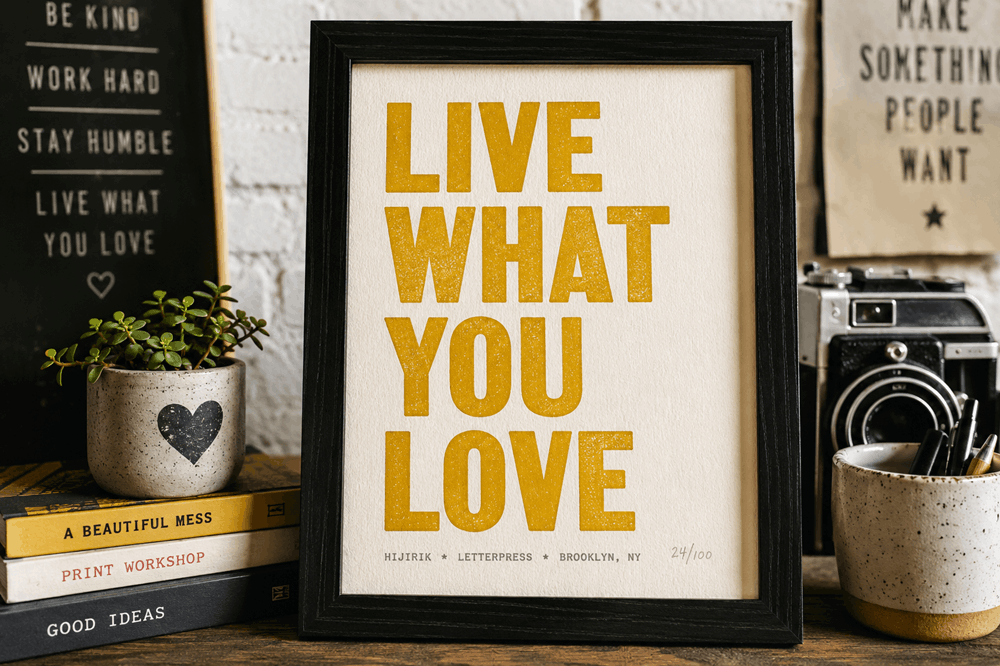
“Live What You Love” sounds like a phrase you have seen on a print, notebook, tote bag, or carefully styled desk photo. It is simple, hopeful, and easy to remember. It can also feel familiar enough to fade into the background.
That is why the old NerdLike giveaway is worth revisiting. In 2009, this was not just a motivational phrase floating through a shopping feed. It was a hand-letterpressed print moving through blogs, comments, RSS, Twitter, Facebook, and Etsy-era creative culture.
Quick Take
The “Live What You Love” print matters because it captures a specific period of online creativity. Independent makers, design bloggers, Etsy sellers, and small web communities helped turn tactile prints into discoverable internet objects.
Today, motivational wall art is everywhere. Some of it feels generic. But a letterpress print still has something digital graphics do not: texture, pressure, ink, paper, slight variation, and the sense that a real person made it with real tools.
Old Post Context
| Old post title | Live What You Love [Giveaway]! |
|---|---|
| Published | November 8, 2009 |
| Featured item | Hijirik “Live What You Love” letterpress print |
| Original giveaway value | $25 |
| Original format | 8×10 hand-letterpressed print, limited edition, frame not included |
| Fresh angle | How small-batch quote prints became part of early creative internet culture |
What the Original Giveaway Was About
The old NerdLike post featured a “Live What You Love” letterpress print from Hijirik, the studio name used by designer and printer Hijiri K. Shepherd. The post described her as a freelance graphic and web designer from New York City who had moved into hand letterpress and linoleum printing.
At the time, the print was part of a limited run. NerdLike described the featured version as an 8×10 print, pressed with vintage wood type blocks on 110lb, 100% cotton Lettra Pearl White paper using soy-based ink.
The giveaway rules were very 2009. Readers could enter by leaving a comment explaining what “Live What You Love” meant to them. They could earn extra entries by subscribing to the site, following on social platforms, tweeting the giveaway, visiting the shop, or blogging about it.
That structure feels old now, but it was exactly how small blogs, indie shops, and creative communities helped each other grow before modern influencer campaigns became more polished and automated.
Why This Was More Than Wall Decor
The interesting part was not only the phrase. It was the chain around it: a designer learning letterpress, readers asking to buy a print, an Etsy shop forming, a blog hosting a giveaway, and commenters explaining what the phrase meant to them.
The object carried a small community story with it. It was not simply a poster someone found through a product grid. It was a print that moved through human recommendations, creative curiosity, and the softer edges of the early maker web.
Why Letterpress Made the Phrase Feel Different
A phrase like “Live What You Love” can easily become background noise. Put it in a generic font, print it cheaply, and it becomes another nice-looking object in a sea of nice-looking objects.
Letterpress changes the feeling.
With letterpress, the words are pressed into the paper. The ink carries texture. The type includes small imperfections. The result is not perfectly flat or perfectly identical. It has the tiny marks of process.
That matters because the phrase is about living with intention. A small-batch print supports that message better than a disposable object does. The medium and the message line up. The print is not only telling you to value what you love. It is also showing the care of someone making something slowly.
The Maker Web Was Different
The late-2000s maker web had a softer pace than today’s shopping feeds. People discovered artists through blogs, Etsy shops, Flickr, Tumblr, RSS, sidebar links, blogrolls, comments, and tiny design communities.
Etsy had launched only a few years earlier, and by 2009 it had already become one of the web’s most recognizable places to discover handmade and small-batch goods. Heartfish Press’s Etsy story fits that moment: the studio history says the “Live What You Love” print began as part of early letterpress class posts, then readers asked whether it was available to buy.
A post like NerdLike’s giveaway was part of that ecosystem. It was not only an ad. It was a bridge between a blogger’s audience and an independent maker.
That kind of discovery felt personal. You might find a print because a blogger liked it. You might enter a giveaway because the question made you think. You might visit a shop and discover notecards, posters, wedding stationery, or another small object that felt more personal than something from a big-box store.
It was commerce, but it was also taste-sharing.
Why Blog Giveaways Worked So Well
Old blog giveaways were simple but powerful. They gave readers a reason to comment, gave bloggers engagement, and gave small makers exposure.
The “Live What You Love” giveaway used the classic formula. The mandatory entry was personal: explain what the phrase means to you. The bonus entries were about community-building: subscribe, follow, tweet, browse the shop, share the post, or comment elsewhere.
Today, that may sound clunky. But it worked because blogs were still places where readers felt present. A comment section could feel like a room. Readers were not just tapping like buttons. They were leaving small pieces of themselves under a post.
For a phrase-driven print, that made sense. The giveaway did not ask readers to only say “I want this.” It asked them to define the message.
The Phrase Is Simple, Maybe Too Simple
“Live What You Love” is not complicated. That is both its strength and its weakness.
Its strength is that almost anyone can project meaning onto it. It can mean building a creative life, choosing work that feels meaningful, making time for family, taking art seriously, protecting joy, or simply not letting daily stress swallow the things you care about.
Its weakness is that phrases like this can become vague. If everything says “follow your dreams,” “do what you love,” or “live your best life,” the words can start to feel like decoration rather than advice.
The print works best when you do not treat it as a magic slogan. It is not telling you that life becomes easy if you chase passion. It is a small reminder to stay near the things that give your life shape.
Why Quote Prints Took Over Home Decor
Quote prints became popular because they are easy to understand and easy to place. You do not need an art degree to respond to a phrase on a wall. You either like the message or you do not.
They also fit the rise of online home styling. A bold type print could make a desk, kitchen, nursery, studio wall, or gallery wall feel more personal. It photographed well. It shipped easily. It made a small space feel intentional.
That is why printed quote art became such a natural Etsy product. It was personal enough to feel meaningful, but simple enough to buy as a gift. It could work in a home office, bedroom, dorm room, craft room, or creative studio.
The danger is sameness. Once the format became popular, the internet filled with endless variations. The best prints still stand out because of craft, typography, paper, color, and restraint.
Why “Live What You Love” Still Has a Place
The phrase still works because it is not trying to be clever. It is direct.
For creative people, it can mean making room for the work that matters even when paid work, errands, inboxes, and obligations take over. For parents, it can mean building a home around care and attention. For students, it can mean not losing yourself while chasing grades or credentials. For anyone tired of algorithmic noise, it can mean choosing real interests over whatever the feed is pushing this week.
That is a modern reading NerdLike readers can still connect with. The phrase is not about quitting everything and turning life into a mood board. It is about noticing what you keep coming back to and giving it more space.
What Makes the Print Feel NerdLike
At first, a letterpress quote print may not seem “nerdy” in the gadget sense. But NerdLike has always had room for design objects, odd finds, craft-driven tools, and internet culture.
This print fits because it sits at the intersection of design, old technology, and online community. Letterpress is old tech. Etsy and blog giveaways were web culture. The phrase became a small object that traveled through links, comments, tweets, and indie-shopping networks.
That is the interesting part. A print made with vintage wood type became popular through the modern web. Old tools met new distribution.
The Beauty of Slow Objects in a Fast Feed
A hand-pulled print feels different now because so much of our design life is screen-based. We see typography all day, but most of it is temporary. It appears in apps, ads, captions, thumbnails, emails, posts, and notifications. Then it disappears.
A letterpress print stays put.
It does not update. It does not notify you. It does not optimize itself. It does not ask for engagement. It simply sits on a wall and waits for you to notice it again.
That kind of object can feel refreshing. In a fast feed, slow physical things become more valuable.
What Changed Since 2009
The maker web is not gone, but it has changed. Etsy is much bigger. Social media is more crowded. Many makers now need Instagram, TikTok, email lists, marketplaces, wholesale channels, and constant content to stay visible.
Discovery is less blog-driven and more algorithm-driven. Instead of finding a print through one trusted blog, you may see it because a platform guessed you might buy it.
That shift is convenient, but something was lost. The old blog post had a human middle layer. A person found an object, liked it, wrote about it, and invited readers to respond. That kind of recommendation felt slower, but also warmer.
How to Think About Motivational Decor Now
Motivational decor is easy to mock because so much of it feels generic. But the better question is not whether quote art is good or bad. The better question is whether the object has enough meaning, craft, or personal connection to earn space in your home.
A phrase on a wall should not be there only because it matches the couch. It should do something for the room. It might remind you of a season in your life, support your creative work, mark a goal, or simply make you smile in a way that lasts longer than a trend.
That is where small-batch prints still have an advantage. They carry process. They carry the maker’s hand. They feel less like filler and more like a small decision.
Final Take
The old “Live What You Love” giveaway was a simple blog post about a small letterpress print. Looking back, it captures a whole era of internet creativity: indie shops, blog discovery, reader comments, RSS, Twitter giveaways, and makers finding audiences one post at a time.
The phrase is simple. Maybe that is why it lasted. A poster cannot fix your life, but a well-made object can still remind you what you meant to make room for.