Freezing videos have a weird hold on the internet. A bottle of water turns to ice in someone’s hand. Boiling water bursts into a snowy cloud. A frozen bubble looks like a tiny glass planet. It is simple, striking, and hard to scroll past.
That may have been the kind of idea behind the old NerdLike page with the slug “ice-cold-and-froze.” The exact post is not recoverable from the live URL, but the title points toward a classic old-blog topic: something cold, frozen, strange, and worth sharing because it looked too cool to ignore.
Quick Take
The internet loves freezing clips because they make everyday physics look like magic. We know water freezes. We know cold weather is cold. But when freezing happens fast, clearly, and with a little drama, it feels surprising again.
That is the key. Freezing videos are not popular because people need a lesson in thermodynamics. They spread because they compress science, danger, beauty, and “wait, how did that happen?” into a few seconds.
Old Post Context
| Old URL clue | ice-cold-and-froze |
|---|---|
| Recovered content | No clean archived copy found |
| Likely format | A short image, video, gadget, or cold-weather curiosity post |
| Fresh angle | Why freezing clips and cold-weather visuals still work online |
What the Old NerdLike Post Was Probably About
The old page was probably a short image or video post. NerdLike posts from that era often highlighted quick internet finds: a strange gadget, a funny image, a design object, a short clip, or a science-like curiosity with one sharp caption.
The phrase “ice cold and froze” suggests a cold-weather gag, a frozen object, a novelty ice idea, or a freezing trick. It does not sound like a long article. It sounds like the kind of post you would publish because one image or clip did most of the work.
That makes this topic a good fit for a fresh NerdLike update. Instead of trying to recreate the missing post, the better move is to ask why these frozen little internet moments keep working.
Why Freezing Looks Like Magic
Freezing is familiar, but it usually happens slowly. You put water in a freezer. You wait. Later, it is ice. That is useful, but not dramatic.
Viral freezing clips change the timing. They show the transformation happening right now. Liquid becomes solid. Vapor turns into a cloud. A clear bubble grows frost patterns. A wet surface becomes slick and dangerous. The state change becomes an event.
That is why these clips feel satisfying. They reveal a process we normally miss. It is the same reason people like time-lapse videos of plants growing, bread rising, metal melting, or paint spreading in strange patterns. The camera turns a physical change into a small performance.
The Instant Ice Bottle Trick
One of the most reliable freezing tricks is the supercooled water bottle. It looks impossible: a bottle of liquid water gets tapped or poured, and suddenly ice spreads through it.
The trick works because very clean, undisturbed water can sometimes be cooled below its normal freezing point without immediately turning solid. It is in an unstable state. In simple terms, the water needs a starting point for ice crystals to form. That starting point is called nucleation.
Once a trigger appears, such as a tap, a rough surface, or an ice crystal, freezing can spread quickly.
This is the same basic reason freezing rain is so nasty. Supercooled droplets can remain liquid while falling, then freeze when they hit roads, trees, power lines, aircraft, or other surfaces. The result is not soft snow. It is a hard glaze of ice.
That is what makes supercooling such good video material. It has a built-in reveal. At first, nothing looks unusual. Then one tiny disturbance changes everything.
Why Boiling Water in Freezing Air Goes Viral
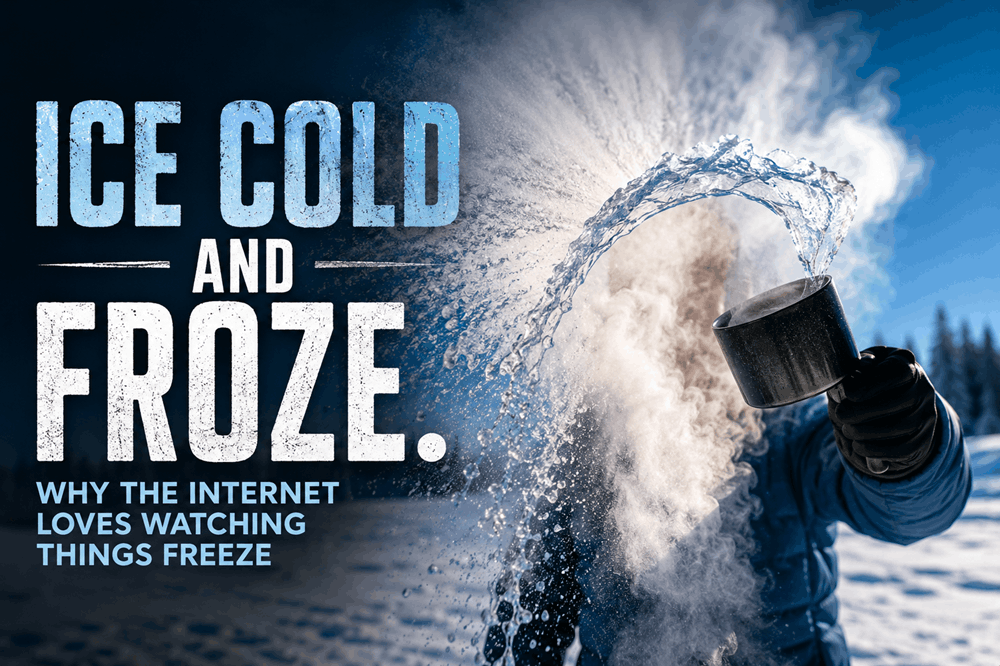
Another classic cold-weather clip shows someone throwing hot water into extremely cold air. The water bursts into a dramatic cloud that looks like instant snow.
The effect is amazing on camera, but it is often misunderstood. It is not just “hot water freezes faster” in a simple way. The hot water breaks into tiny droplets, evaporates quickly, and the very cold air cannot hold much water vapor. The vapor condenses and freezes into a bright cloud of tiny ice particles and droplets.
It looks like a magic spell because it turns motion, temperature, and air into one clean moment. The arc of water becomes a ghostly white plume. The colder the setting, the more unreal it looks.
It is also risky and not worth copying casually. Boiling water can blow back, especially in wind, and can burn the person throwing it or someone nearby. This is one of those internet science moments that is better watched than recreated.
Cold Weather Makes Hidden Forces Obvious
Part of the appeal of extreme-cold videos is that cold reveals things we usually do not notice.
Breath becomes vapor. Water becomes ice. Car windows frost over. Snow squeaks underfoot. Metal sticks to skin. Pipes burst. Lakes crack and groan. Wind turns a normal temperature into something your body experiences much more harshly.
The cold is not just a number on a weather app. It becomes something you can see, hear, and feel.
That is why cold-weather videos often feel more dramatic than heat videos. Heat can shimmer, melt, burn, or warp things, but cold has a clean transformation language. It locks, crystallizes, coats, hardens, and preserves.
Frozen Bubbles Are the Pretty Version
Frozen bubble videos are the softer side of the genre. Instead of danger or shock, they offer beauty.
A soap bubble lands in freezing air, and ice crystals begin to crawl across the surface. The patterns look delicate and almost alive. The bubble becomes a tiny frozen world, then collapses.
These videos work because they are fragile. The viewer knows the bubble will not last. That gives the clip a little tension. It is not only “watch this freeze.” It is “watch this before it disappears.”
That temporary beauty is perfect for short video feeds. A frozen bubble is quick, quiet, camera-friendly, and easy to understand without sound.
Why We Like Seeing Objects Fail in the Cold
Not every freezing clip is beautiful. Some are funny because normal objects suddenly stop behaving normally.
A door will not open. A hose becomes stiff. A soda can explodes. A phone shuts down. A lock refuses to turn. A car disappears under ice. A pair of jeans freezes upright.
These clips are satisfying because they remind us that technology and everyday objects are not separate from the physical world. Cold does not care that something is convenient, expensive, or smart. It changes materials, drains batteries, thickens fluids, and exposes weak points.
That is very NerdLike. The joke is not only “look, it froze.” The better joke is that our supposedly modern stuff still has to obey basic physics.
The Science Is Simple Enough to Feel Personal
Freezing videos also work because the science feels close to everyday life. You do not need a lab to understand the basic idea. Water, air, cold, ice, and surfaces are familiar.
That makes the clips approachable. A viewer may not know the word “nucleation,” but they can understand that water sometimes needs a starting point to turn into ice. They may not know the details of vapor pressure, but they can see hot water turn into a cloud in bitter air.
Good internet science often works this way. It gives people the phenomenon first and the explanation second. The clip opens the door.
Phone Cameras Made Cold Tricks Easier to Share
Part of the reason these clips spread is that they do not need a production setup. A phone camera, a cold day, and one clean transformation are enough.
That matters. The best freezing clips usually have a clear before-and-after moment. Liquid, then ice. Hot water, then cloud. Bubble, then frost. Normal object, then frozen failure.
The camera catches the change, the clip loops well, and the explanation can come later in the caption or comments. That makes freezing tricks perfect for TikTok, Instagram Reels, YouTube Shorts, Reddit, and X.
Where Freezing Videos Can Mislead People
The downside is that dramatic clips can make the science look simpler than it is.
For example, boiling-water-in-cold-air videos are often described as “hot water instantly turns to snow.” That is close enough for a casual caption, but not precise. The cloud is a mix of rapid evaporation, condensation, and freezing of tiny droplets. It is not the same as a neat snowflake forming in slow motion.
Supercooled water clips can also make freezing look easier to control than it is. The effect depends on temperature, purity, container conditions, disturbance, and timing. That is why some people try it and only get a normal cold bottle of water.
This does not ruin the fun. It just means the best version of the internet clip should come with a little context. Wonder is better when it survives the explanation.
Why “Ice Cold” Still Feels Like a Good Internet Phrase
There is also a language reason this topic works. “Ice cold” is simple, punchy, and flexible. It can mean temperature, attitude, style, danger, or drama. It feels like a caption before you even know the clip.
That made it perfect for old blogs. A title like “Ice Cold and Froze…” could attach to almost anything: a frozen gadget, a cold-weather stunt, a design object made of ice, or a weird science clip. The phrase does not need much setup.
That is how many early internet posts worked. The title gave you the vibe. The image or video delivered the payoff.
How This Has Changed Since 2010
In 2010, a frozen image or short clip might spread through blogs, email forwards, forums, Tumblr, or early social feeds. A blogger could post one weird thing and become part of the chain that moved it around the web.
Today, the same idea lives mostly in short video feeds. TikTok, Instagram Reels, YouTube Shorts, Reddit, and X all reward quick payoff. A freezing clip does not need much editing. The transformation is the edit.
The format has changed, but the hook is basically the same: show something normal turning strange in a way people can understand instantly.
What Makes a Good Freezing Clip?
A good freezing clip usually has three things.
First, the setup is clear. The viewer knows what they are looking at: water, a bubble, a car, a lake, a window, a bottle, a mug, or a frozen street.
Second, the change happens in a way the eye can follow. Ice forms, vapor appears, crystals spread, or an object fails in a way that feels immediate.
Third, the clip has a tiny emotional hook. It is beautiful, funny, dangerous, satisfying, or confusing. Without that feeling, it is just cold.
The best clips make you want to replay them once, then learn why they happened.
Final Take
The internet loves freezing videos because they turn basic physics into quick drama. They make water, air, temperature, and surfaces behave in ways that feel surprising, even though the science is sitting right in front of us.
That is probably why an old NerdLike post with a title like “Ice Cold and Froze…” made sense in the first place. Cold is naturally camera-friendly. Frozen things are naturally clickable. A good ice clip does not need much explanation to feel worth sharing.
Whether it is instant ice, frozen bubbles, ice-covered cars, or hot water vanishing into a winter cloud, the appeal is the same. We like watching the ordinary world change state. For a few seconds, the weather becomes a special effect.