
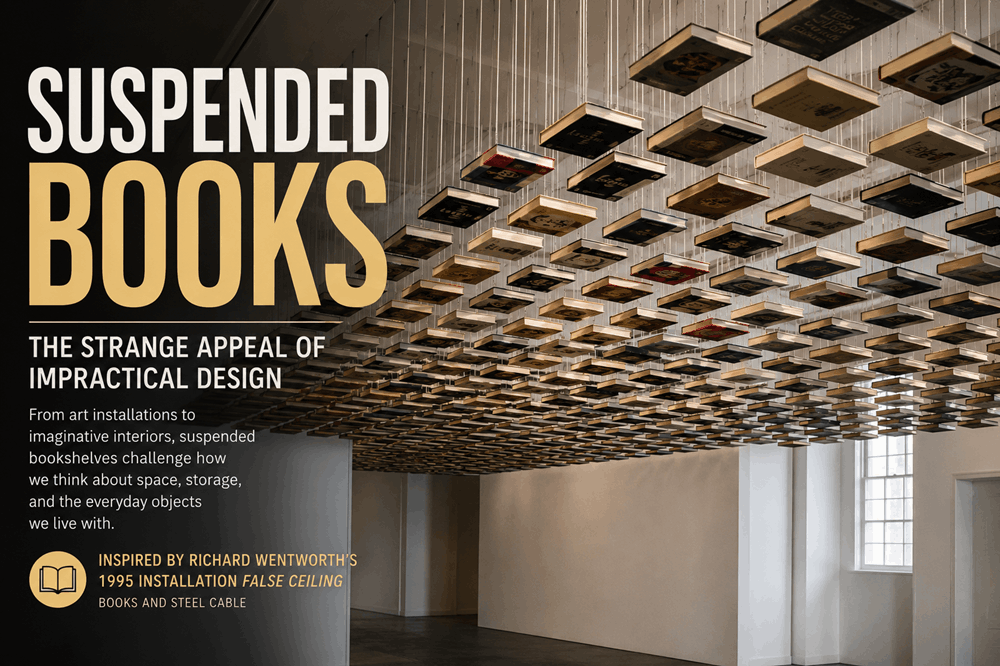
Some design ideas are useful because they solve a problem. Others are useful because they make you stop and look twice.
Suspended books belong in that second category.
At first, the idea sounds simple: books hanging above you, floating in space, with no normal shelf underneath them. It feels like storage, but it is not really storage. It looks like furniture from a distance, but the closer you look, the more it behaves like art.
That is why this old idea still works in 2026. Not because everyone should hang books from the ceiling. Most people should not. It works because it turns a familiar object into something strange enough to notice again.
The Art Behind the Idea
The idea connects back to Richard Wentworth’s False Ceiling, a 1995 installation that suspended books from the gallery ceiling using steel cable.
That detail matters because the work was not designed as a practical bookshelf. It was not a clever home-storage hack. It was an art installation built around ordinary objects placed in an unexpected position.
A normal bookshelf says: here are books, neatly stored.
False Ceiling says something less direct: why do books belong where we expect them to belong?
That small shift changes the whole mood. Books stop being background objects. They become weight, shadow, texture, and tension. They become part of the room itself.
Why the Idea Still Feels Fresh
In 2026, home design is pulled between two strong desires.
People want rooms to be practical. They also want spaces that feel personal, interesting, and visually memorable. That is why floating shelves, wall-mounted storage, modular bookcases, and hidden brackets remain popular. They save space while still giving a room some style.
Suspended books push that idea further.
They do not just use the wall differently. They use the air above the room. They make books feel less like items in storage and more like part of the architecture.
That is the appeal.
The idea is not only about where books go. It is about what happens when everyday objects are moved into a place where they do not quite belong.
The Problem: It Is Not Very Practical
A suspended-book installation is probably a terrible everyday bookshelf.
Books are heavy. Ceilings vary. Anchors, brackets, cables, and load limits matter. A poorly installed hanging shelf or book display can damage a ceiling or become unsafe. This is not the kind of project to improvise with random hooks and wishful thinking.
Access is another problem.
A shelf should help you use your books. If the books are too high, too awkward, or too delicate to move, the object becomes display rather than storage.
That does not make the idea bad. It just means we should understand what kind of idea it is.
Suspended books are not trying to beat a normal bookcase. They are trying to make books feel surprising.
When Impractical Design Still Has Value
Impractical design gets dismissed too easily.
Not every object has to be the most efficient version of itself. Some objects exist to create mood, curiosity, conversation, or tension. A chair can be uncomfortable and still be important as a design statement. A lamp can give weak light and still change how a room feels. A shelf can fail as storage but succeed as a visual idea.
Suspended books work in that same space.
They remind us that design is not only about convenience. It is also about imagination. It can ask why objects sit where they sit, why rooms are arranged the way they are, and why usefulness is often treated as the only goal.
Books are especially powerful for this because they already carry meaning. They feel personal. They suggest memory, taste, study, clutter, status, comfort, or ambition.
Move them overhead, and that meaning changes.
The Safer Modern Version
A full ceiling of suspended books belongs in an art space, gallery, studio, or carefully engineered installation. For a normal home, it is usually too much.
Still, the idea can inspire safer design choices.
A modern version might use wall-mounted floating shelves, a small cable-supported display installed by someone who understands the weight requirements, or a decorative hanging element using lightweight book-like forms rather than actual heavy books.
A creative studio, bookstore, library event, or gallery space could also use the concept more naturally than a regular living room.
The key is honesty.
Is it storage?
Is it display?
Is it art?
Those are different goals. A design that fails at one can still succeed at another, but only if you know what you are asking it to do.
Why Floating Shelves Won the Practical Battle
For real homes, floating shelves won for obvious reasons.
They give people the visual effect of objects hovering on a wall while staying easier to install, reach, clean, and style. They work for books, plants, speakers, framed art, collectibles, bathroom products, kitchen items, and small everyday objects.
They are not as dramatic as suspended books, but they are much easier to live with.
That contrast is useful.
Floating shelves show design as a daily tool. Suspended books show design as a question. One helps organize your apartment. The other makes you rethink what a shelf can be.
Both have value, but they belong in different places.
Why Nerdlike Readers Should Care
Nerdlike is built around clever technology, design, apps, gadgets, internet culture, and the strange little ideas that make everyday life more interesting.
Suspended books fit that world well.
The concept is simple, but the reaction is not. It makes people ask whether the idea is brilliant, ridiculous, dangerous, beautiful, or all of those things at once.
That is what makes it worth revisiting.
It is the same kind of curiosity that makes people stop for an unusual gadget, a clever desk setup, an experimental chair, a strange lamp, or a tiny house design that solves a problem in an unexpected way.
Even when the object is not practical, the thought behind it can still be useful.
Final Take
Suspended books are probably not the smartest way to store a reading collection.
That is fine.
Their real value is not storage. Their value is surprise. They take something ordinary and move it into a position where people have to look at it differently.
Richard Wentworth’s False Ceiling still works because it sits between art and design. It looks almost useful, but refuses to be useful in the usual way. It makes books feel familiar and unfamiliar at the same time.
That is why the idea has lasted.
The best design does not always make life easier. Sometimes it simply makes the room ask a better question.


