
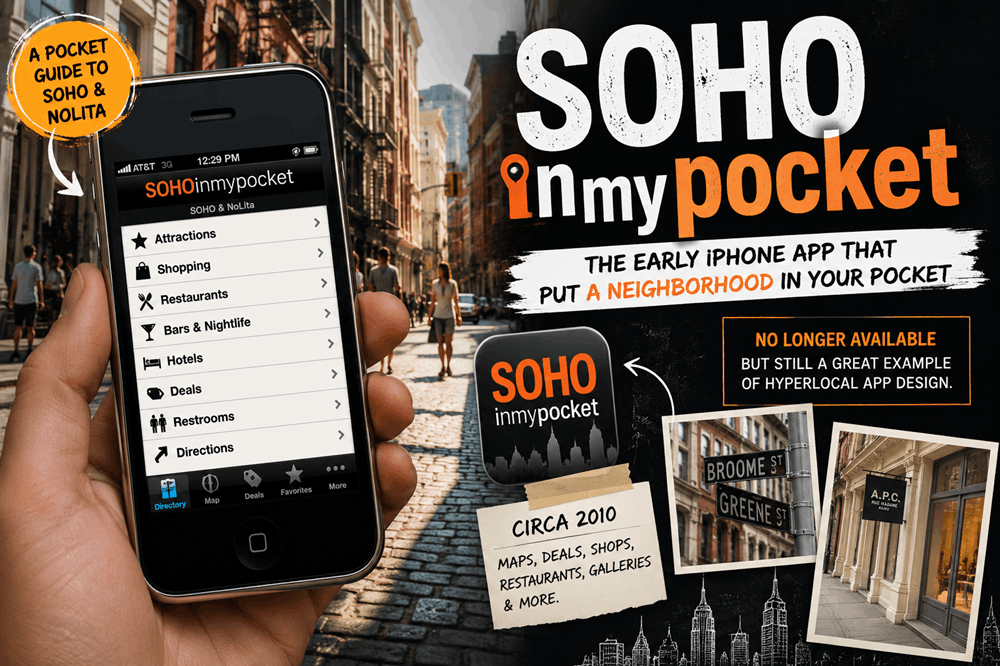
Editor’s note: SOHOinmypocket appears to be discontinued today, and its original App Store listing is no longer publicly available. This article looks back at the app as an early example of hyperlocal mobile city guides, not as a current download recommendation.
Before every phone had powerful maps, saved places, reviews, photos, delivery links, and live business hours, small local apps tried to make cities easier to explore one neighborhood at a time.
SOHOinmypocket was one of those apps.
It was built for SoHo and NoLita in New York City, and its promise was simple: put the neighborhood in your pocket. Shops, restaurants, bars, galleries, hotels, deals, directions, and local points of interest were all supposed to live inside one focused iPhone guide.
In 2010, that idea felt useful and fresh. In 2026, the app itself looks like a piece of mobile history. But the idea behind it still has something to teach us.
What Was SOHOinmypocket?
SOHOinmypocket was an iPhone app designed as a local guide for the SoHo and NoLita neighborhoods of lower Manhattan.
Instead of trying to cover all of New York City, it focused on a tight area packed with shops, restaurants, galleries, hotels, bars, and attractions. The app included a directory, maps, directions, local deals, photos, and location-based features.
That narrow focus was its biggest strength.
SoHo and NoLita are easy to find on a map, but they are not always easy to explore well. The area is dense, stylish, busy, and full of side streets. You can walk past a great shop, small gallery, or quiet cafe without noticing it. A focused local guide was meant to help with that.
SOHOinmypocket was not trying to replace wandering. It was trying to make wandering smarter.
Why a Dead App Still Deserves a Fresh Article
Writing about a discontinued app can seem strange at first. After all, readers cannot download it and use it like a normal app recommendation.
But that is exactly why the angle matters.
SOHOinmypocket is not useful today as a download. It is useful as a snapshot of what early iPhone apps were trying to become.
Back then, the phone was turning into a city tool. Developers were testing ideas around GPS, local search, mobile maps, merchant deals, and walking-friendly directories. People were starting to expect their phone to help them decide where to go next, not just call someone or check email.
That shift is now normal. In 2026, most of us barely think about it. We open a map, search “coffee near me,” check photos, compare reviews, save a place, and walk there.
SOHOinmypocket came from the earlier moment when that behavior still felt new.
The App’s Best Idea Was Focus
Modern apps often try to show everything.
That can be powerful, but it can also be exhausting. Search results get crowded. Review scores blur together. Sponsored listings appear. Every place has photos, ratings, comments, menus, hours, and mixed opinions. Sometimes finding a simple answer feels harder than it should.
SOHOinmypocket had a different approach: focus on one neighborhood and make it easier to move through that specific place.
That is still a smart idea.
A good local guide does not need to show every possible result. It needs to help someone make a better choice in the moment. Where should I shop? Where can I eat nearby? What is worth seeing on this block? Is there a deal close to me? Can I find directions without digging through a dozen menus?
The app’s narrow design made sense because SoHo and NoLita are not just locations. They are walking neighborhoods. The value was in helping users explore on foot.
What Feels Dated Now
A lot has changed since the early iPhone app era.
A 2010-style local guide would feel limited today if it did not have live hours, recent photos, updated business listings, accessibility details, reliable walking directions, transit context, and privacy controls.
The biggest problem with any neighborhood app is maintenance.
Stores close. Restaurants move. Galleries change. Deals expire. Hours shift. A guide that feels helpful one month can feel outdated the next if nobody keeps it fresh.
That is especially true for SoHo and NoLita, where retail, food, tourism, and real estate change constantly.
There is also the privacy issue. In 2010, GPS features felt exciting because they made the phone feel aware of the world around you. In 2026, location access is still useful, but users are more cautious. A modern version of SOHOinmypocket would need to explain why it wants location data, offer approximate-location options when possible, and avoid unnecessary tracking.
The feature that once felt magical now has to earn trust.
What Modern Apps Do Better
Today, most people would use Google Maps, Apple Maps, Yelp, Tripadvisor, Instagram, TikTok, or travel guides to explore SoHo and NoLita.
Those tools are better at scale. They can cover far more businesses, update more often, show photos, surface reviews, and connect users to directions in seconds. They also work across cities instead of locking users into one small area.
That is a huge advantage.
Modern map apps are also better at practical tasks. They can show whether a place is open, how long it takes to walk there, what the storefront looks like, whether it is busy, and what other people recently said about it.
SOHOinmypocket could not compete with that today as a simple directory.
But it may have had something modern tools often lack: a stronger sense of local personality.
Big platforms are useful, but they can feel generic. They are great at showing what is nearby. They are not always great at telling you what fits the mood of a neighborhood.
That is where a curated local guide can still win.
What a 2026 Version Could Be
A modern SOHOinmypocket would need to be more than a map with pins.
It would need to feel like a smart walking companion for SoHo and NoLita.
A strong version could include curated walking routes, short shopping trails, food stops by mood, gallery notes, quiet places to sit, restroom tips, pop-up alerts, local sales, and quick guides for people with limited time.
It could answer practical questions like:
Where should I go if I only have one hour?
Where can I grab coffee and sit for a bit?
What shops are good for gifts?
What is open nearby right now?
Which streets are best for a casual walk?
What places feel more local and less obvious?
That kind of app would not need to beat Google Maps at being huge. It would need to beat it at being selective.
That is the opportunity old hyperlocal apps pointed toward but did not always fully reach.
The Bigger Lesson for App Design
SOHOinmypocket reminds us that not every useful app has to become a giant platform.
Some apps are valuable because they solve one clear problem for one specific situation.
The problem here was simple: SoHo and NoLita are packed with things to do, but that can make them overwhelming. A visitor, shopper, or curious local might want a quick way to find good places nearby without turning the afternoon into research.
That problem still exists.
Even with better tools, people still get lost in options. They still want confidence. They still want shortcuts. They still want a local layer that feels more human than a search box.
The best version of this idea is not just “show me places near me.”
It is “help me enjoy where I already am.”
Why This Fits Nerdlike
Nerdlike is interested in apps, gadgets, digital life, internet culture, and the way technology changes everyday behavior. SOHOinmypocket fits because it shows an early version of something we now take for granted.
Your phone knows where you are.
Your phone can tell you what is nearby.
Your phone can guide you through a neighborhood.
That seems ordinary now, but it was once exciting enough for small developers to build entire apps around one part of one city.
That is worth remembering.
SOHOinmypocket also fits because it shows how quickly app ideas age. A tool can be useful, clever, and well-timed in one era, then disappear when bigger platforms absorb the same job. That does not make the old app meaningless. It makes it part of the story.
Many dead apps helped teach the phone what it was supposed to become.
Final Take
SOHOinmypocket is not an app most people can use today, but it was built around a good idea.
A city guide should make a place easier to explore. It should help people notice better options, move with more confidence, and make faster decisions without killing the fun of wandering.
That balance is hard.
Too little information leaves you guessing. Too much information turns a simple walk into homework. The best local tools sit somewhere in the middle.
SOHOinmypocket tried to live in that middle space. It wanted to be a pocket-sized guide for a stylish, crowded, easy-to-miss neighborhood.
In 2026, the app is gone, but the dream behind it is still alive.
Put the neighborhood in your pocket.
Then help people actually enjoy it.


