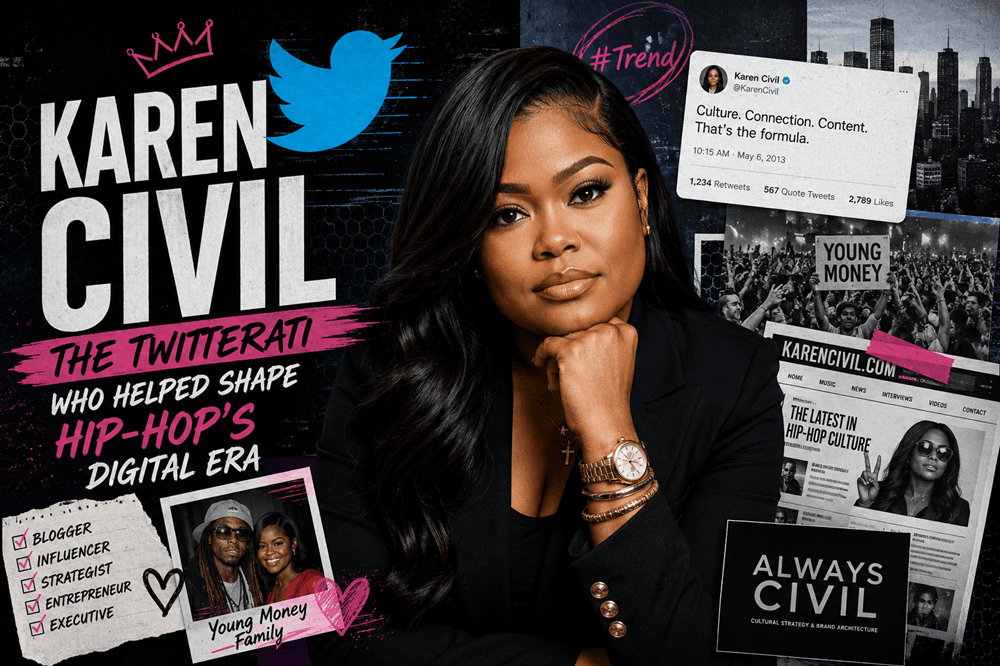
“Twitterati” feels like a word from another internet lifetime.
It belongs to the early social media era, when Twitter was still the place where tastemakers, bloggers, artists, fans, and industry insiders could shape a conversation in real time. A smart post, a sharp co-sign, or the right online connection could move faster than a magazine feature or a radio interview.
Karen Civil became one of the names tied to that moment.
A fresh look at her career is not just about revisiting an old Twitter-era profile. It is about understanding how early online media helped change hip-hop marketing, artist storytelling, fan access, and the business of attention.
Before every creator had a “personal brand,” Civil was already showing how a person with taste, timing, relationships, and internet fluency could build something bigger than a feed.
Who Is Karen Civil?
Karen Civil is a media personality, entrepreneur, and brand builder whose work has crossed hip-hop, entertainment, sports, public campaigns, and community-focused projects.
She became widely known through hip-hop media and online fan culture. Her site, KarenCivil.com, helped position her as more than someone reporting on entertainment. It gave her a platform, a voice, and a direct line to an audience that cared about music, artists, interviews, and the business around hip-hop.
That matters because the music media landscape was changing fast.
For years, magazines, radio, television, and major labels controlled most of the conversation. Then blogs, YouTube, Twitter, and direct-to-fan updates started changing the rhythm. Artists could speak faster. Fans could respond instantly. Bloggers could break stories, introduce artists, or give momentum to a moment before traditional outlets caught up.
Civil’s rise happened inside that shift.
What the Twitterati Era Meant
The “Twitterati” label was not only about having followers.
It described a new kind of public influence. These were people who could read the room online, understand what fans cared about, and make conversations travel. Some were journalists. Some were bloggers. Some were artists, DJs, stylists, managers, comedians, or early creators. What connected them was their ability to shape attention.
In hip-hop, that mattered deeply.
Hip-hop has always moved through co-signs, street-level credibility, word of mouth, radio, mixtapes, visuals, and personality. Twitter added another layer. It made those signals public and immediate.
A blog post could introduce a new artist. A tweet could send fans to a song. A behind-the-scenes photo could make people feel closer to a campaign. A direct message, reply, or public shoutout could create movement around a name.
The old gatekeepers did not disappear, but they had new competition.
Civil understood that early. She treated the internet less like a bulletin board and more like a live cultural space.
From Blogger to Brand Builder
The most interesting part of Karen Civil’s story is that she did not stay in one lane.
Many early bloggers became known for posting music, gossip, interviews, or industry updates. Civil used that media presence as a starting point. Over time, her work expanded into brand campaigns, cultural positioning, artist storytelling, business partnerships, and executive-level opportunities.
That is the real lesson in her career.
The blog helped build visibility. Social media helped grow reach. Industry relationships helped open doors. But the larger move was turning audience trust into real-world leverage.
That is something many creators still struggle with today.
Getting attention is one skill. Turning attention into a lasting business is another.
The Lil Wayne and Young Money Connection
One of the most important chapters in Civil’s public career is her long connection to Lil Wayne and Young Money.
Her work around WeezyThanxYou became a strong example of early direct-to-fan communication. During Lil Wayne’s incarceration, the site gave fans a place to read messages connected to him and feel closer to an artist who was physically removed from the spotlight.
That was smart for its time.
It showed that fans did not only want polished promotion. They wanted access. They wanted updates. They wanted personality. They wanted to feel included in the story.
Years later, Civil was reported to have been promoted to General Manager and Executive Vice President of Young Money. Whether someone follows her as a media figure, marketer, or executive, that step showed how online-era influence could move into formal music-industry leadership.
The path from fan connection to executive work is exactly why her career fits this conversation.
Why Her Approach Worked
Civil’s rise worked because she understood audience behavior before it became a standard marketing lecture.
She knew that hip-hop fans care about access. They want to see the artist, but they also want to understand the world around the artist. They care about the music, the movement, the people nearby, the timing, and the story behind a campaign.
She also understood that online attention has to feel human.
A campaign that feels too stiff can fail even with a big budget. A smaller moment can travel if it feels close to the audience. Civil’s strongest work sat near that line: media, marketing, relationship-building, and fan conversation.
That mix helped her move across different spaces without being tied to one platform.
Beyond One App
The old version of this topic would have focused mostly on Twitter.
That made sense in 2013. It does not make sense now.
In 2026, no serious media operator can build only for one platform. The audience is split across Instagram, TikTok, YouTube, podcasts, newsletters, streaming platforms, live events, and private communities. Twitter, now X, is only one piece of a much larger system.
That makes Civil’s career more relevant, not less.
The useful lesson is not “be good at Twitter.” The lesson is “understand how attention moves.”
Platforms change. Formats change. Algorithms change. But the deeper skill is knowing how people discover something, why they trust it, and what makes them share it.
Civil’s career shows that the real asset was never just posting. It was reading the audience before the audience became obvious.
A Brief Move Into Politics
Civil’s work has also reached beyond music and entertainment.
During the 2016 presidential cycle, she was covered for helping connect Hillary Clinton’s campaign with younger audiences through popular culture and social media. That moment is worth mentioning because it shows how hip-hop-adjacent media skills had become valuable outside the music industry.
But this article is not about politics. It is about the internet’s role in changing who gets to shape public attention.
Civil’s career shows how someone rooted in music media could move into larger conversations around brands, campaigns, and audience connection.
That is the larger point.
A Lesson for Today’s Creators
For creators, bloggers, marketers, and small media brands, Karen Civil’s path offers a clear lesson: do not build only for the platform you are using right now.
Build a point of view.
A social account can rise quickly and fall just as fast. A platform can change rules. An algorithm can bury posts. A trend can disappear in a week.
A point of view travels better.
Civil built around access, hip-hop, fan connection, media presence, and business relationships. That gave her room to move from blogging to brand work, from social media to executive roles, from online attention to larger campaigns.
That is more durable than chasing one viral moment.
A lot of people can get noticed. Fewer people know what to do after the attention arrives.
Why Nerdlike Readers Should Care
Nerdlike covers gadgets, apps, digital life, internet culture, and the more interesting corners of modern media. Karen Civil’s story fits because it shows how online tools changed who could shape entertainment.
This is not a hardware story, but it is absolutely an internet story.
The tools were websites, social feeds, video clips, fan updates, and direct audience access. The result was a new kind of media power. People who understood the web could compete with older outlets, build their own platforms, and turn niche credibility into wider opportunity.
That shift changed music. It changed celebrity. It changed branding. It changed politics. It changed how fans expect to hear from public figures.
Civil was one of the people who made that shift easier to see.
The Modern Takeaway
The word “Twitterati” may sound dated, but the idea behind it is still alive.
Every platform era creates people who understand how attention works before everyone else catches up. Some use that attention for noise. Others use it to build something with reach, value, and staying power.
Karen Civil’s career belongs in the second category.
Her story is not only about being online early. It is about turning online visibility into media ownership, brand work, music-industry roles, and broader audience-building.
That is why the topic still works now.
Not because Twitter is what it used to be. It is not.
It works because the larger question is still current: who understands the internet well enough to turn attention into impact?
Karen Civil helped answer that question during the Twitterati era. The answer still matters.