You probably see internet memes before you even finish your morning scroll. They pop up in group chats, social media feeds, comment sections, and videos, often saying exactly what everyone is thinking in one funny image, clip, or phrase.
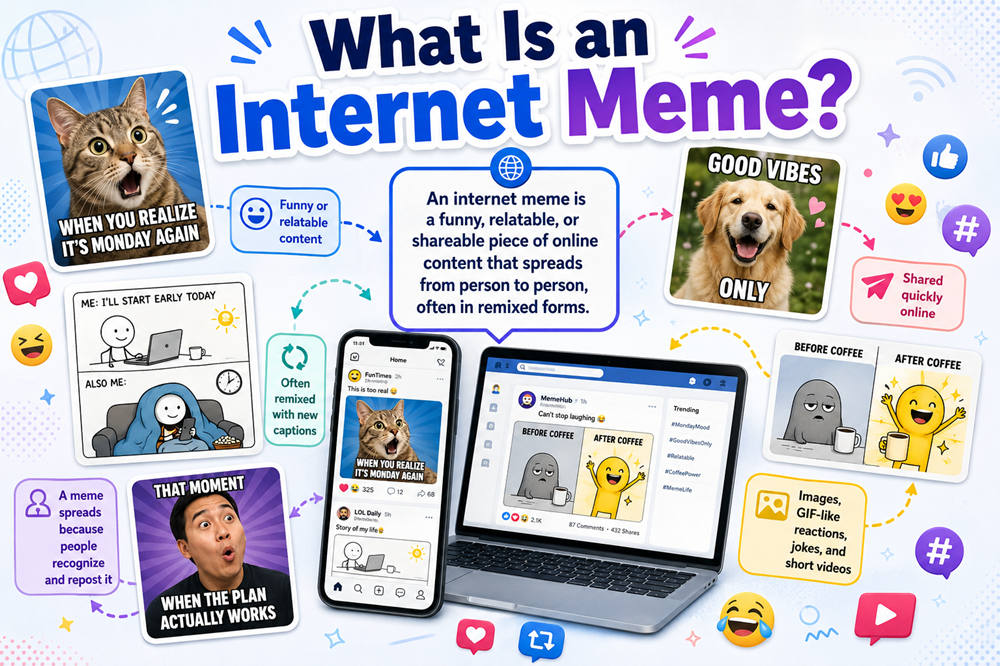
So, what is an internet meme? An internet meme is a piece of online content that spreads because people find it funny, relatable, clever, or perfectly timed. It can be a picture, video, joke, reaction, sound, phrase, or trend that people share and adapt in their own way.
What Is an Internet Meme?
An internet meme is a digital joke, idea, or format that people use to express something quickly online.
It might be a captioned image, a short video, a reaction GIF, a copied phrase, or a TikTok sound. The format usually stays familiar, but people change the meaning by adding their own caption, situation, or twist.
For example, the famous “Distracted Boyfriend” meme uses one photo to show temptation, distraction, or bad priorities. The picture stays the same, but the labels change depending on the joke. One version might be about procrastination. Another might be about choosing snacks over a healthy meal.
That flexibility is what makes memes so popular. A good meme gives people a quick way to say, “This is exactly how I feel.”
Where Did Internet Memes Come From?
The word “meme” was popularized by writer Richard Dawkins in the 1970s. He used it to describe how ideas, behaviors, and cultural habits spread from person to person.
The internet gave the word a new life.
Online, memes move much faster than traditional cultural ideas. A joke can start on Reddit, spread to TikTok, land on Instagram, and end up in your family group chat within days. Sometimes it happens even faster.
Early internet memes often came from forums, message boards, image-sharing sites, and email chains. Today, memes can come from almost anywhere: TikTok videos, celebrity interviews, sports moments, movie scenes, livestreams, screenshots, or random everyday posts.
How Internet Memes Work
Memes work because they are easy to recognize and easy to personalize.
Usually, a meme starts with a funny image, phrase, video, sound, or situation. People connect with it, then use the same format to make their own version. That repeated format creates the joke.
A meme does not need to be complicated. In fact, simple memes often spread the fastest because people understand them right away. A single facial expression, short caption, or dramatic video clip can say more than a long paragraph.
Think about reaction GIFs. If someone sends you shocking news, you might reply with a GIF of a person gasping, blinking, or staring in disbelief. You do not have to explain your reaction because the meme does it for you.
That is the real power of memes. They turn emotions and everyday moments into something instantly shareable.
Common Types of Internet Memes
Internet memes come in many forms. Some are based on images. Others depend on video, sound, text, or trends. Here are the most common types you will see online.
Image Memes
Image memes are the classic version most people recognize.
They usually feature a picture with a caption, label, or punchline. The image might come from a movie, TV show, stock photo, cartoon, news clip, or viral social media post.
Examples include “This Is Fine”, “Woman Yelling at a Cat”, and “Drakeposting”. These memes became popular because the images are easy to reuse in different situations.
Image memes are especially good for quick jokes about work, school, relationships, stress, money, parenting, and awkward social moments.
Video Memes
Video memes are short clips that people quote, edit, duet, stitch, or reuse.
They can come from TV scenes, interviews, TikToks, YouTube videos, sports highlights, or livestreams. Sometimes one line becomes the meme. Other times, it is a facial expression, awkward pause, dance, or dramatic reaction.
TikTok helped make video memes even bigger. A single sound can inspire thousands of different videos. People use the same audio but apply it to their own situations, which keeps the trend fresh.
Video memes work well because timing matters. The pause, music, voice, or movement can make the joke funnier than text alone.
Text Memes
Text memes rely mostly on words.
They can be tweets, short captions, copied joke formats, fake conversations, or repeated sentence patterns. You might see them as screenshots, social posts, comments, or plain text in a group chat.
For example, a simple setup like “Me pretending to understand…” can be used for jokes about school, work meetings, taxes, technology, or any confusing situation.
Text memes are popular because they are easy to copy and quick to change. You do not need editing skills. You just need a relatable idea and the right wording.
Reaction Memes
Reaction memes show how someone feels.
They can be images, GIFs, short clips, or screenshots used as replies. You might use one to show shock, embarrassment, joy, confusion, disappointment, or sarcasm.
Reaction memes are common in comments and group chats because they make conversations more expressive. Instead of typing “I cannot believe that happened,” you can send a shocked reaction image that says it better.
They are basically the facial expressions of the internet.
Trend Memes
Trend memes are built around a format many people repeat.
These include TikTok challenges, audio trends, dances, filters, caption styles, and recurring joke formats. The fun comes from seeing how different people use the same setup in their own way.
Some trend memes last for months. Others disappear in a week. That short lifespan is part of internet culture. What feels hilarious today might feel outdated very quickly.
Why Internet Memes Become Popular
Memes become popular when they are easy to understand, easy to share, and easy to relate to.
Relatability is one of the biggest reasons. A meme about being tired on Monday morning works because so many people know that feeling. A meme about awkward small talk, unpaid bills, bad Wi-Fi, or waiting for a text can spread for the same reason.
Timing also matters. Memes often explode after major events, celebrity moments, sports games, award shows, or viral videos. When everyone is already talking about something, a funny meme gives people a quick way to join the conversation.
Memes also make people feel included. When you understand the joke, you feel like you are part of the group. That shared understanding is why memes are so common in fandoms, gaming communities, school circles, workplaces, and online subcultures.
A strong meme does not just make people laugh. It makes them want to send it to someone else.
Why Memes Matter Online
Memes may look simple, but they play a big role in how people communicate online.
They help people react quickly. They can make serious topics easier to discuss, turn frustrating moments into jokes, and give people a way to express feelings without overexplaining.
Memes also reflect culture. When something big happens in entertainment, sports, politics, or everyday life, memes often appear almost immediately. They show what people noticed, what they found funny, and what they are thinking about.
They also bring communities together. Fans of the same show may share jokes only they understand. Students may bond over exam memes. Workers may laugh at office memes because they recognize the same daily frustrations.
In that way, memes are more than online jokes. They are a casual language people use to connect.
Are Internet Memes Always Funny?
No, internet memes are not always funny.
Many are meant to make people laugh, but others are sarcastic, emotional, political, educational, or critical. Some memes explain ideas. Some mock trends. Some express frustration. Others respond to serious news with dark humor or social commentary.
A meme can look silly but still carry a real message. For example, a joke about burnout may be funny because it is exaggerated, but it can also point to real stress people feel at work or school.
Some memes are also confusing when you do not know the background. A meme might depend on a specific TV scene, celebrity moment, video game, viral post, or inside joke from a certain community.
That is normal. Not every meme is made for every audience.
Examples of Internet Memes in Everyday Life
You probably run into memes more often than you realize.
A friend might send a reaction GIF when you share surprising news. A coworker might post a meme about meetings that could have been emails. A student might share a joke about studying the night before an exam. A sports fan might post memes after a dramatic win or painful loss.
Memes also show up around entertainment. Movie trailers, award shows, album releases, celebrity interviews, and reality TV moments can all become meme material. Sometimes a single facial expression from a red-carpet clip turns into hundreds of jokes.
Brands and public figures use memes too, though it can feel awkward when they try too hard. Memes usually work best when they feel natural, timely, and connected to the way people already talk online.
How to Understand a Meme You Don’t Get
Everyone sees memes they do not understand. It does not mean you are behind. It usually means you are missing the context.
Start with the caption. It often explains the situation while the image or video shows the emotion. Then look at the format. Is it a reaction image, a repeated phrase, a TikTok sound, or a joke template?
Comments can also help. People often add clues, explain the reference, or repeat the joke in different ways. If the meme is tied to a viral moment, current event, show, game, or celebrity, a quick search can give you the missing background.
It also helps to remember that memes are often like inside jokes. A gaming meme may not make sense if you do not play that game. A fan meme may not land if you have never watched the show. A workplace meme may feel funnier if you have lived through the same situation.
Sometimes you are in on the joke. Sometimes you are just seeing it from the outside.
Final Thoughts
Internet memes are a fast, creative part of online culture. They can be funny, sarcastic, emotional, critical, or simply relatable.
What makes a meme powerful is how quickly it communicates a feeling or idea. With one image, clip, phrase, or sound, people can react to the world around them and invite others to laugh, agree, or join in.
That is why memes have become more than internet jokes. They are part of the way we talk online.