
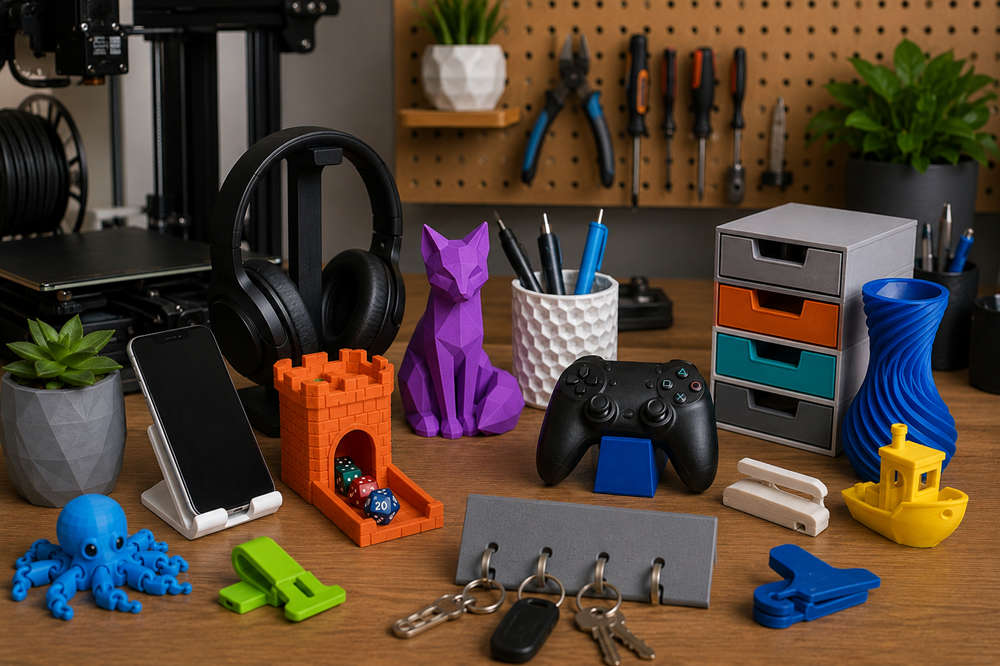
A 3D printer is at its best when it turns a small idea into something you can actually use. That might be a cable clip that cleans up your desk, a controller stand that makes your gaming setup look sharper, a drawer divider that fits your space perfectly, or a tiny replacement part that saves something from being thrown away.
The coolest things to 3D print are not always huge or complicated. Many of the best prints are small, clever, and practical. They solve everyday problems, make a room feel more personal, or give you a fun weekend project without requiring a full workshop.
This guide focuses on 50+ realistic 3D print ideas for beginners, hobbyists, gamers, home organizers, and more experienced makers. Some are simple enough for a first print. Others are better once you understand supports, tolerances, filament choice, and assembly.
Easy Starter Prints for Beginners
If you are new to 3D printing, begin with small objects that print quickly and teach useful basics. These projects help you learn bed adhesion, sizing, supports, and surface quality without wasting much filament.
1. Cable Clips
Cable clips are one of the most practical first prints because almost every desk, nightstand, and entertainment center needs them. Print small clips for USB-C cables, phone chargers, headphone wires, HDMI cables, or power cords.
For a desk, choose clips with a flat base that can attach with double-sided tape. For thicker cords, use a wider opening so the cable does not pinch. PLA is fine for most indoor cable clips, especially if they are not under heavy tension.
2. Phone Stand
A phone stand is simple, useful, and easy to customize. A basic angled stand works well for watching videos, checking notifications, using a recipe app, or keeping your phone visible while working.
The most useful designs leave space for a charging cable at the bottom. Before printing, check whether the slot is wide enough for your phone case. Slim stands look clean, but they may not fit larger phones with rugged cases.
3. Wall-Mounted Key Holder
A printed key holder can be a small wall rack, a magnetic shelf, or a simple row of hooks near the door. It is a satisfying beginner project because the shape is usually simple, but the result can improve your daily routine.
For better strength, use a model with screw holes instead of relying only on adhesive. A neutral filament color can help the holder blend into an entryway, while a brighter color makes it easier to spot when you walk in.
4. Bag Clips
Bag clips are handy for snack bags, coffee bags, frozen food bags, craft supplies, and small hardware packets. They print quickly, so it makes sense to produce several at once.
Thicker clips usually last longer than ultra-thin designs. A good bag clip should close tightly without being difficult to open. Print one test clip first, then make a batch if the hinge and grip feel right.
5. Custom Bookmark
A 3D-printed bookmark uses very little filament and gives you a chance to test fine details. Try a flat bookmark, a corner bookmark, or a design with raised text and a simple pattern.
Keep the bookmark thin enough that it will not damage book pages. If you want to make it feel more personal, add initials, a small icon, or a shape connected to the reader’s favorite genre.
6. Small Drawer Organizer
A drawer organizer is a perfect example of why 3D printing is useful. Instead of buying a tray that almost fits, you can print bins in the exact sizes you need.
Use small trays for paper clips, screws, SD cards, USB adapters, lip balm, batteries, pens, craft supplies, or keyboard switches. For a cleaner drawer, print several organizers with the same wall height so the pieces line up neatly.
7. Plant Labels
Plant labels are quick, simple, and easy to personalize. Print thin stakes for herbs, seedlings, houseplants, or garden beds.
Raised lettering is easier to read over time than marker ink, especially outdoors. PLA works well for indoor plants, but outdoor labels may last longer with a more weather-resistant filament.
8. Toothpaste Squeezer
A toothpaste squeezer slides onto the end of a tube and helps push the paste forward as it empties. It is small, funny, and genuinely useful.
The slot should be wide enough for thicker tubes but tight enough to stay in place. Similar designs can also work for hand cream, paint tubes, ointment tubes, or travel-size toiletries.
Desk and Tech Accessories Worth Printing
Desk accessories are perfect for 3D printing because modern setups are full of small objects that need holders, mounts, trays, and cable control. A few well-chosen prints can make a workspace feel cleaner and more intentional.
9. Headphone Stand
A headphone stand keeps your headset off the desk and protects the ear pads from being crushed under books, keyboards, or other gear. Print a freestanding stand, an under-desk hook, or a wall-mounted hanger.
For gaming headsets, use a design with a rounded top so the headband does not rest on a sharp edge. Heavy headphones need a wide base or screw-mounted support.
10. Laptop Feet
Laptop feet raise the back of your laptop slightly, improving the typing angle and creating more space underneath for airflow. They are smaller than a full laptop stand and easy to carry in a bag.
Look for feet with a non-slip shape or add rubber pads after printing. Avoid using PLA feet in hot cars or sunny window areas, since heat can soften or deform the print.
11. Laptop Cooling Stand
A full laptop cooling stand is better for a permanent desk setup. It can lift the laptop higher, improve airflow, and make a second-screen workspace more comfortable.
Choose a design with open channels under the laptop instead of a solid surface that blocks vents. Wider stands are more stable, especially for larger laptops.
12. SD Card and MicroSD Card Holder
If you use cameras, drones, handheld gaming devices, 3D printers, or single-board computers, loose memory cards can disappear fast. A printed holder keeps them organized and easy to check.
For travel, use a closed case with a lid. For a desk drawer, an open tray is faster to use. Make sure the slots are snug enough that microSD cards do not slide out when the holder is moved.
13. USB Cable Organizer
A USB cable organizer can separate charging cords, camera cables, HDMI adapters, and short data cables. It is more useful than a basic clip when you have several cords in the same drawer or on the same desk.
Use a desktop version near your monitor for daily cables and a tray-style organizer inside a drawer for spares. Labeling the slots can help if you have several similar-looking cables.
14. Controller Stand
A controller stand gives console, PC, or handheld gaming controllers a proper place to sit. It keeps thumbsticks and triggers from being pressed inside a drawer.
For one controller, a simple angled stand is enough. For multiple controllers, print a vertical rack or wall-mounted row. The best designs support the controller near the grips rather than putting pressure on delicate buttons.
15. Webcam Cover
A sliding webcam cover is a tiny privacy print for laptops, monitors, and external webcams. It usually has a thin frame and a small sliding tab.
This print needs careful sizing. If it is too thick, it can stop a laptop from closing properly. If the slider is too loose, it may fall out. Print a low-profile version and test it gently before leaving it attached.
16. Phone Charging Dock
A charging dock holds your phone and cable in one place, so you can drop the phone into position instead of hunting for the cord. It is useful on a desk, nightstand, or kitchen counter.
Check the cable shape before printing. Some docks are designed around a specific USB-C or Lightning connector. If your phone has a thick case, use a dock with extra clearance around the bottom and back.
17. Keyboard Switch Tester
A keyboard switch tester is a fun print for mechanical keyboard fans. It holds several switches so you can compare sound and feel without building a full keyboard.
A small 4-switch tester works as a desk toy, while a larger grid can display a switch collection. The openings need to be accurate, so this is also a useful tolerance test for your printer.
18. Router Wall Mount
A router wall mount can clean up a messy network corner by moving the router off the floor or desk. It also makes it easier to route cables neatly.
Leave room for antennas, power cables, Ethernet ports, and airflow. Do not trap a warm router inside a tight printed shell. For most mounts, PETG is a better choice than PLA if the device runs warm.
19. Mini-PC Mount
A mini-PC mount can attach a small computer under a desk, behind a monitor, or on a wall. It is useful for compact workstations, media centers, home servers, or emulator boxes.
Measure the device carefully, including rubber feet, ports, and ventilation. A good mount holds the computer securely without blocking airflow or making cables hard to reach.
Smart Home and Everyday Organization Prints
Some of the most satisfying prints are not flashy. They quietly make your home easier to live in by giving small things a proper place.
20. Wall Hooks
Printed wall hooks can hold keys, hats, headphones, lightweight bags, masks, charging cables, or small tools. They work well in entryways, closets, bathrooms, garages, and home offices.
Use adhesive only for light items. For anything heavier, print a hook with screw holes and mount it properly. PETG is often better than PLA for hooks that need more toughness.
21. Drawer Dividers
Drawer dividers are ideal for kitchen utensils, office supplies, makeup, tools, craft items, and junk drawers. They keep the drawer flexible instead of locking you into one store-bought tray shape.
A modular system works best. Print short walls, corner connectors, and small bins that can be rearranged later. This way, the drawer can change as your stuff changes.
22. Remote Control Holder
A remote control holder can sit on a coffee table, attach to the side of a couch, or mount on a wall near the TV. It keeps remotes from disappearing under blankets or between cushions.
Separate slots help if you have remotes for a TV, soundbar, streaming device, and game console. A slightly angled holder makes each remote easier to identify at a glance.
23. Toothbrush Stand
A toothbrush stand gives each brush a clean, separate place. It can make a shared bathroom counter feel less chaotic.
Drainage matters. Pick an open design with holes or raised supports so water does not collect at the bottom. Bathroom prints should be easy to rinse and dry.
24. Razor Stand
A razor stand keeps the blade area off the counter and helps the razor dry between uses. It is useful for small sinks, shower shelves, or travel kits.
Choose a stable base so the razor does not tip over. Avoid enclosed designs that trap water around the blade.
25. Battery Organizer
A battery organizer is perfect for AA, AAA, coin cell, 9V, and rechargeable batteries. It keeps loose batteries from rolling around in drawers and makes it easy to see what you have.
Some designs separate charged and dead batteries. That is especially helpful if you use rechargeable batteries for controllers, flashlights, toys, or camera gear.
26. Pegboard Tool Holders
Pegboard tool holders are excellent for workshops, craft rooms, and maker spaces. Print holders for screwdrivers, pliers, hex keys, scissors, measuring tools, or small parts bins.
The advantage is specificity. Instead of buying a generic pegboard kit, you can print a holder for one exact tool. If the tool changes, print a new holder instead of reorganizing the whole wall.
27. Modular Storage Bins
Modular storage bins are great for screws, bolts, LEGO pieces, keyboard switches, craft beads, 3D printer nozzles, cables, and small electronics parts.
Choose a bin system with matching dimensions so the pieces stack or grid together. Raised labels or label slots make the system much easier to maintain.
28. Cord Wraps
Cord wraps keep small cables, extension cords, headphones, and appliance cords from tangling. They are useful in drawers, backpacks, camera bags, and travel pouches.
For flexible wraps, TPU is the best material. For rigid spool-style wraps, PLA or PETG works well indoors.
Kitchen Prints That Are Useful but Need Common Sense
Kitchen prints can be genuinely useful, but direct food contact needs care. For most hobby printers, the safest kitchen projects are food-adjacent: clips, holders, stands, organizers, and tools that do not repeatedly touch wet or sticky food. Direct food-contact prints require more planning because FDM layer lines can trap residue and are difficult to clean thoroughly.
29. Chip Clips
Chip clips are easy to print and useful in almost every kitchen. Use them for chips, cereal bags, coffee bags, frozen vegetables, pet treats, or pantry refills.
Print a few different sizes. Short clips are good for snack bags, while longer clips work better for wide coffee or cereal bags. Test one hinge before making a full batch.
30. Coffee Scoop Holder
A coffee scoop holder keeps your scoop from getting buried in beans or disappearing into a drawer. It can clip onto a coffee container, hang from a shelf, or sit beside a grinder.
This print is especially useful for a home coffee station. Pair it with a small tray for filters, stirrers, or measuring spoons so the whole area stays organized.
31. Measuring Spoon Organizer
A measuring spoon organizer keeps spoons separated by size instead of tangled in a drawer. Some designs use horizontal slots, while others hang the spoons vertically.
Readable size labels make the organizer much easier to use while baking. Check that the slots fit your actual spoon set before printing a large holder.
32. Fridge Magnet Hooks
Fridge magnet hooks can hold lightweight items like small towels, keys, grocery lists, bag clips, or measuring spoons. Many designs include circular holes where small magnets can be pressed or glued into place.
Check the magnet size before printing. A useful hook with the wrong magnet hole size becomes annoying fast. Keep the load light; this is a convenience print, not heavy storage.
33. Sponge Holder
A sponge holder keeps the sponge off the counter and helps it dry more easily. Open sides, drainage holes, or a tilted shape help prevent water from pooling.
Avoid enclosed boxes that trap moisture. If you print in PLA, keep it away from boiling water, dishwasher heat, and very hot sink areas.
34. Recipe Card Stand
A recipe card stand keeps printed recipes, note cards, or small cookbook pages visible while you cook. It is a simple print that makes a kitchen counter feel less cluttered.
A wide base helps prevent tipping. Since this type of print sits near food prep areas, choose a design that is easy to wipe clean.
35. Tablet Stand for Cooking
A tablet stand is useful for recipe apps, cooking videos, timers, and grocery lists. It needs more stability than a small phone stand because tablets are heavier.
Use a wide, low base and check the slot width if your tablet has a thick case. Keep it away from burners, steam, and splashes.
Gaming and Hobby Prints
3D printing is a natural fit for hobbies because hobby gear is often oddly specific. A printer lets you make custom objects that would be hard to find in a normal store.
36. Dice Tower
A dice tower turns a simple dice roll into a little event. Dice drop through internal ramps and roll out at the bottom, which helps keep rolls fair and contained during tabletop games.
Simple towers can print as one piece. More detailed versions may include a removable tray, decorative walls, or multiple parts. Add felt or thin foam to the tray if you want quieter rolls.
37. Miniature Terrain
Miniature terrain can make tabletop role-playing games and strategy games feel more immersive. Print stone walls, crates, barrels, ruins, stairs, rocks, sci-fi panels, or dungeon tiles.
Start with small scatter pieces before printing large buildings. Smaller terrain prints help you test detail settings and give you practice with painting.
38. Game Card Holder
A game card holder is useful for board games, trading card games, and family games with lots of cards. It can hold a draw pile, discard pile, player hand, or several decks at once.
If you use sleeved cards, check the internal width carefully. Sleeves add just enough thickness to cause fit problems in holders designed for bare cards.
39. Controller Wall Mount
A controller wall mount turns gaming gear into part of the room setup. It works for PlayStation, Xbox, Nintendo, retro, and PC controllers.
Print one mount per controller and line them up near your console or desk. A strong mount supports the controller by the grips, not by the buttons or triggers.
40. Board Game Insert
A board game insert organizes cards, tokens, dice, tiles, miniatures, rulebooks, and player pieces inside the original box. It makes setup and cleanup much faster.
This type of print can take longer because it often uses several trays. Before printing, check whether the insert supports sleeved cards if you use them.
41. Figurine Display Stand
A figurine display stand gives small collectibles, miniatures, amiibo-style figures, or painted models a cleaner presentation. It can be a simple riser, a multi-tier shelf, or a themed base.
For shelves with several figures, print matching stands at different heights. This makes the display easier to see without needing a larger shelf.
42. VR Headset Wall Mount
A VR headset wall mount keeps the headset off the floor, away from cables, and easier to grab. It can also hold controllers if the design includes side hooks.
Mount it somewhere away from direct sunlight, since sunlight can damage VR lenses. Use screws instead of adhesive for heavier headsets.
Decorative Prints for Rooms and Setups
Decorative prints are where you can experiment with color, texture, lighting, and shape. These objects may not solve a daily problem, but they can make a desk, shelf, studio, or gaming room feel more personal.
43. Geometric Lampshade
A geometric lampshade can create interesting shadows and make a simple LED light look custom. Honeycomb shapes, waves, angular panels, and repeating patterns tend to look especially good when lit from inside.
Use low-heat lighting and avoid placing PLA near hot bulbs. Treat this as a decorative cover for safe lighting, not a high-heat fixture.
44. Low-Poly Animal Sculpture
Low-poly animals look clean and modern without requiring extreme detail. Foxes, cats, owls, dinosaurs, whales, and dogs all work well in this style.
These prints are good for shelves, desks, and gifts. Matte filament often looks especially nice because the flat surfaces catch light in a sculptural way.
45. Wall Art Tiles
Printed wall art tiles can create a small accent wall, studio backdrop, or decorative panel behind a desk. Try repeating hexagons, waves, relief patterns, or abstract geometric shapes.
This project can grow slowly. Print four tiles first, test the layout on the wall, then add more if the pattern works in the room.
46. Planter
A printed planter is a great way to experiment with shape. Ribbed, faceted, hanging, and tiny succulent planters are all popular because they look custom without being hard to use.
Drainage is important. Use a design with a drainage hole, or place a nursery pot inside the printed shell so water does not sit against the print.
47. Vase
A printed vase can be decorative on its own or used with dried flowers. Spiral, ribbed, and parametric designs show off the texture of 3D printing nicely.
Many FDM prints are not naturally watertight. Use a liner or sealant if you want the vase to hold water.
48. Photo Lithophane
A lithophane turns a photo into a thin 3D print that reveals the image when light shines through it. It looks plain at first, then comes alive when backlit.
Use a bright, high-contrast photo and a light-colored filament. Lithophanes work well as night lights, window decorations, framed gifts, or lamp panels.
Repair and Advanced Maker Prints
Repair and advanced prints can be some of the most rewarding projects. They often require more measuring and testing, but they show what makes 3D printing different from buying ready-made objects.
49. Replacement Knob
Replacement knobs are useful for drawers, cabinets, appliances, lamps, and small tools. A printed knob can be round, ridged, wing-shaped, or custom-sized for better grip.
Measure the screw size, shaft shape, and depth before printing. If the knob needs to handle twisting force, add wall thickness and consider a tougher material than basic PLA.
50. Broken Clip or Bracket Replacement
Plastic clips and brackets are easy to break and often hard to buy separately. A 3D printer can make light-duty replacements for battery covers, cable clips, storage bins, appliance covers, curtain parts, or small mounting brackets.
Accurate measuring matters. Even a one-millimeter difference can make a clip too loose or too tight. Print a small test piece first if the shape needs to snap into place.
51. Furniture Spacer or Foot
Custom spacers, shelf supports, chair feet, table shims, and furniture pads can fix small household annoyances. They can level a wobbly item, protect a floor, or fill a small gap.
For furniture feet, use a wider base for stability. Add felt or rubber after printing if the part touches the floor.
52. Vacuum or Tool Adapter
Adapters are one of the smartest functional prints. They can connect parts that were never designed to fit together, such as a shop vacuum hose and a tool dust port.
Measure both ends carefully and check whether the adapter needs a taper. PETG is often a better choice than PLA for adapters that may see more stress or heat.
53. Articulated Creature
Articulated dragons, snakes, lizards, robots, and fish are popular because they print with moving segments. Many come off the build plate already flexible.
These prints test bed adhesion and printer accuracy. If the joints fuse together, your tolerances may be too tight or your printer may need calibration.
54. Mechanical Clock
A printed mechanical clock is a serious project for someone who enjoys moving parts. It may include gears, axles, weights, hands, and a frame that all need to work together.
This is not a quick decorative print. It requires patience, clean print settings, and careful assembly, but the finished object can be much more satisfying than a simple display piece.
55. RC Car Parts
RC hobbyists can print body parts, mounts, battery trays, bumpers, servo brackets, wheels, and test parts for custom builds. This is useful because hobby parts often need small adjustments.
PLA may work for prototypes, but impact, heat, and vibration can require tougher materials. Print orientation matters because layer direction affects strength.
56. Cosplay Armor Piece
Cosplay armor is one of the most dramatic 3D printing projects. Helmets, shoulder pieces, gauntlets, chest plates, and props can be printed in sections and assembled later.
The print is only the beginning. Most cosplay pieces need sanding, filler, primer, paint, straps, and padding. Start with a small prop before committing to a full helmet or armor set.
57. Camera Rig Accessory
Camera rig prints can include lens cap holders, cable clips, cold shoe adapters, battery trays, monitor mounts, handle grips, and small brackets.
Test the fit with the camera over a soft surface. Do not trust a thin printed part to hold expensive gear unless the design is strong, well-tested, and mounted correctly.
58. Printer Upgrade
Using your printer to improve your printer is one of the most satisfying parts of the hobby. Common upgrades include filament guides, tool holders, spool holders, scraper holders, cable chains, fan ducts, and enclosure accessories.
Start with simple upgrades that organize your workspace. More technical upgrades, such as fan ducts or hotend-related parts, should be chosen carefully because they can affect print performance.
Where to Find Good 3D Print Models
There are many places to browse printable files. Printables is useful for browsing active categories and community makes. Thingiverse remains one of the most recognizable 3D model libraries. MakerWorld is another strong place to browse models, especially if you like ready-to-print projects and community collections.
Before downloading a model, look beyond the preview image:
- Look for real user photos, not only rendered previews.
- Check whether the designer included print settings.
- Read recent comments for fit, slicing, or strength issues.
- See whether the model needs supports.
- Check the estimated print time and filament use.
- Review the license before remixing or selling prints.
A model with several successful makes is usually safer than a file with no feedback. License terms matter too. Some models are free for personal use but not for commercial use.
Tips Before You Start Printing
Start small, especially if you are trying a new filament or a model from a designer you have never used before. A quick print can tell you a lot about fit, strength, and surface quality.
For beginner-friendly projects, look for phrases like “support-free,” “no supports,” or “print-in-place.” These models are usually easier to print and require less cleanup.
PLA is a good starting filament for decorative objects and light-duty indoor prints. PETG is often better for tougher everyday items, bathroom pieces, and warmer areas. TPU is useful for flexible objects such as bumpers, grips, and cord wraps.
Orientation matters too. The way a part sits on the build plate can affect strength, surface quality, and support needs. For functional prints, think about how the part will be pulled, pressed, twisted, or mounted before choosing the orientation.