Editor’s note: This article looks back at the “Baby Snuggie” as a 2009 internet and product-culture moment. It is not a current baby product recommendation. Parents and caregivers should follow current infant safety guidance and use only age-appropriate products as directed.
The late 2000s were a special time for strange comfort products.
The Snuggie had turned a blanket with sleeves into a pop-culture joke, a holiday gift, an infomercial hit, and a surprisingly clear design reference. Blogs were hungry for odd products. Anything cozy, awkward, or easy to explain in one headline could become part of the daily internet conversation.
That is where the “Baby Snuggie” fits.
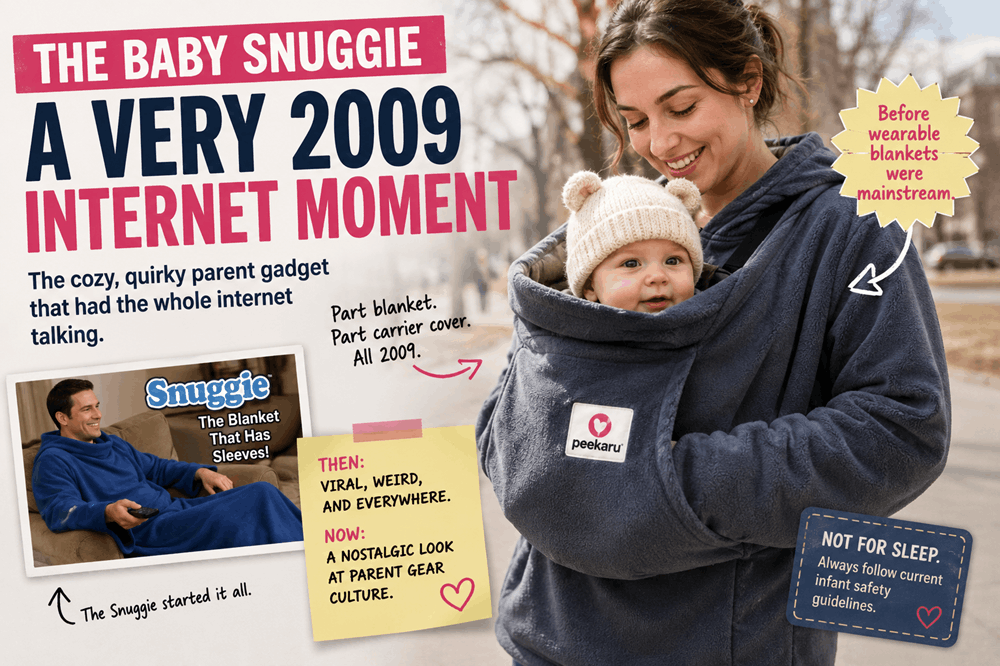
The product behind the nickname was closer to a fleece baby-carrier cover than a crib blanket or infant sleep product. It was often discussed online as the Peekaru, a pouch-like layer designed to be worn over a baby carrier so a parent could keep a baby close and warm while moving around.
The nickname stuck because people already understood the Snuggie formula: take a normal comfort idea, make it wearable, and let the internet decide whether it is clever, ridiculous, or both.
What Was the Baby Snuggie?
The “Baby Snuggie” was not really a tiny version of the adult Snuggie.
It was a parent-worn babywearing accessory that covered the adult and baby together while the baby was in a carrier. The baby’s head stayed visible, while the warm layer helped cover the rest of the setup.
That distinction matters.
A carrier cover, a blanket with sleeves, a sleep sack, a swaddle, and a crib blanket are not the same thing. They may all be connected to warmth, but they serve different purposes and come with different safety considerations.
The Baby Snuggie nickname made the product easier to talk about, but it also blurred the details. In 2009, that made for a funny headline. In 2026, it needs more explanation.
Why It Became an Internet Moment
The Baby Snuggie caught attention because it landed at the perfect intersection of product design, parenting gear, and meme culture.
It was visual. It was easy to summarize. It connected to a product everyone already knew. It also solved a problem that many parents could understand: keeping a baby warm while carrying them outside is not always simple.
Normal coats, carriers, wraps, blankets, and layers can become awkward. A parent may need free hands, a comfortable baby, and enough flexibility to move through errands, walks, or cold weather without turning every outing into a gear puzzle.
So the idea itself was not pointless.
What made it internet-ready was the presentation. A baby’s head sticking out of a parent-worn fleece pouch looked unusual enough to make people stop, laugh, share, and argue about whether it was brilliant or absurd.
That was classic 2009 product-blog energy.
The Snuggie Effect
The original Snuggie worked because it lived in a strange middle zone.
People laughed at it, but many also understood the appeal. A blanket with sleeves sounds silly until you are cold on the couch and still want to use your hands. That small practical need made the joke more durable.
The Baby Snuggie idea worked in a similar way.
At first glance, it looked odd. But if you have ever carried a baby in cold weather, the basic problem makes sense fast. Babies need warmth. Parents need mobility. Not every coat or blanket works neatly with a carrier.
That is why products like this are interesting. They can look strange while still pointing to a real need.
The better question is not “does this look normal?” The better question is “what problem was it trying to solve, and did it solve that problem safely and clearly?”
Baby Gear Needs a Different Standard
A novelty desk gadget can be useless and still be harmless. A strange lamp can be more conversation piece than tool. But baby products sit in a more serious category.
Comfort is not enough. Cute is not enough. Viral attention is not enough.
Anything involving babies has to be judged by safety, age-appropriateness, instructions, fit, airflow, overheating risk, and intended use. A product can be cozy and still be wrong for the wrong situation.
That is why a 2026 look at the Baby Snuggie should not read like a casual joke post from 2009.
The product may be fun to revisit as internet culture, but babywearing and infant sleep safety are not casual topics. Parents need clear information, not cute confusion.
This Was Not a Sleep Product
This is the most important boundary: a Baby Snuggie-style carrier cover should not be treated like an infant sleep blanket.
Modern safe-sleep guidance is much clearer than the older product-blog era often made it seem. Babies should sleep on a firm, flat surface with loose blankets, pillows, toys, bumpers, and other soft items kept out of the sleep space.
That does not mean every wearable baby product is unsafe. It means purpose matters.
A carrier cover is for use with a baby carrier, while the caregiver is awake and attentive. A sleep sack is designed for sleep. A swaddle has its own use rules. A loose blanket in a crib is different again.
Those categories should not be mixed together.
The Baby Snuggie nickname was memorable, but it also shows how a catchy label can make a product sound simpler than it really is.
What the Idea Got Right
The Baby Snuggie idea had one smart insight: baby gear often needs to work for the parent and baby together.
A lot of baby products focus on one fixed setting: the crib, stroller, car seat, nursery, or changing table. But real parenting is full of motion. Parents carry, walk, adjust, check, feed, pack, unzip, relayer, and try to keep going while holding a baby close.
A parent-worn carrier cover recognizes that reality.
It is not only about keeping the baby warm. It is about helping the adult move through normal life with less friction. That is a real design problem.
The product looked unusual because the problem itself is awkward. Babies are small, carriers are structured, coats are shaped for one body, and weather does not care if your setup is convenient.
Good parent gear tries to make that mess easier.
What a Safer Modern Comparison Looks Like
A modern version of the Baby Snuggie idea would need calmer branding and clearer instructions.
It would need to explain exactly what it is for: babywearing, not crib sleep. It should say what kinds of carriers it works with, what age or size range it supports, how to keep the baby’s face visible, how to avoid overheating, and when not to use it.
It should also be clear about related but different product categories.
Babywearing covers can help with warmth during carrying. Properly used carriers help keep the baby positioned against the caregiver. Sleep sacks are for sleep when used as directed. Weather-appropriate clothing can help with layering. These items may all involve warmth, but they are not interchangeable.
That is the kind of clarity parents deserve.
A clever product name can get attention. Clear safety guidance builds trust.
What Feels Dated Now
The name feels dated first.
“Baby Snuggie” only lands if people remember how big the Snuggie was as a joke and comfort product. In 2009, that reference was instant. In 2026, it feels more like internet nostalgia.
The old product-blog tone also feels dated.
Many posts from that era treated odd parenting products mostly as visual jokes. That was common at the time, but it feels incomplete now. Baby gear needs more careful framing because the real-world use matters more than the headline.
The marketing expectations have changed too. Parents now expect better product photos, clearer sizing, washing details, safety notes, carrier compatibility, temperature guidance, and direct explanations of what a product should not be used for.
A cozy idea still has to explain itself.
Why Nerdlike Still Cares
Nerdlike covers gadgets, apps, digital life, internet culture, and the strange product ideas that show how people live with design.
The Baby Snuggie fits that mix because it is more than a baby product nickname. It is a snapshot of how the internet used to turn small products into shared moments.
It shows how the Snuggie became a cultural shortcut. It shows how parenting gear can become viral when it looks unusual. It also shows how product writing has changed.
In 2009, the easy question was: does this look ridiculous?
In 2026, the stronger question is: what need was this product trying to meet, and how should we talk about it responsibly now?
That makes the topic worth revisiting.
Final Take
The Baby Snuggie was a very 2009 idea.
It was cozy, awkward-looking, easy to share, and tied to one of the most recognizable comfort-product memes of its time. It belonged to an era when blogs could turn a niche item into a conversation because the image alone was enough.
Looking back now, the topic is bigger than the nickname.
It shows how comfort products become culture. It shows how parents are always looking for ways to make daily life easier. It shows how a product can look unusual while still pointing to a real problem.
Most of all, it reminds us that not every odd-looking product is simply a joke.
Sometimes a strange-looking product is really a familiar parenting problem trying to find a better shape.

